The 7 Types of Power Problems That Are Silently Damaging Your Equipment
Your servers crash at 2 AM. Your PLC resets mid-production. Your LED panels flicker during peak hours. The utility says "power is fine." They're right - and wrong. The problem isn't that power is absent. It's that it's dirty. Here are the seven ways your power supply is degraded, described using IEEE Standard 1159 terminology.
The IEEE 1159 Classification
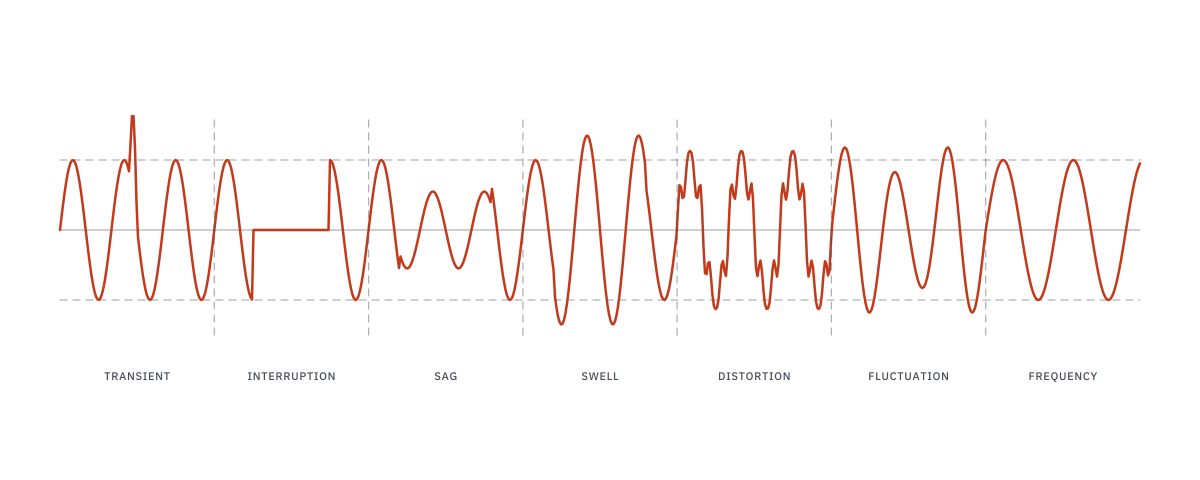
IEEE Std 1159-2019, "Recommended Practice for Monitoring Electric Power Quality," defines how power disturbances are described; the seven groups below use its terminology (it also covers voltage imbalance). Understanding each one is the first step to protecting your equipment.
| # | Problem | Duration | Voltage Effect | Primary Cause |
|---|---|---|---|---|
| 1 | Transients | < 50 ns to 1 ms | Spikes of thousands of volts | Lightning, switching, capacitor discharge |
| 2 | Interruptions | 0.5 cycles to minutes | Complete loss (0V) | Faults, breaker operation, utility outage |
| 3 | Sag / Undervoltage | 0.5 cycles to 1 min | 10-90% drop | Large motor starting, overloaded circuits |
| 4 | Swell / Overvoltage | 0.5 cycles to 1 min | 10-80% rise | Load switching, capacitor bank energizing |
| 5 | Waveform Distortion | Continuous | Distorted sine wave | Harmonics from VFDs, UPS, LED drivers |
| 6 | Voltage Fluctuations | Intermittent | Random 0.1-7% swings | Arc furnaces, welders, intermittent loads |
| 7 | Frequency Variations | Variable | Normal V, wrong Hz | Generator instability, islanding events |
1. Transients - The Silent Killer
Transients are the most destructive power problem. A lightning strike can induce a spike of several thousand volts on a 120V circuit. Even internal transients from switching motors or capacitor banks can exceed the normal peak voltage for a very short time - long enough to punch through semiconductor junctions and destroy circuit boards.
Industry sources commonly report that most transients are generated internally - from your own equipment, not from the utility or lightning. Every time a relay clicks, a motor starts, or a compressor cycles, a transient is born.
Protection: Surge Protective Devices (SPDs) at the service entrance (Type 1), distribution panels (Type 2), and point-of-use (Type 3). Layered protection - called a "cascaded SPD approach" - is the most effective strategy.
2. Interruptions - The Obvious One
Complete loss of power for any duration. This is the one everyone thinks about, but it's actually among the least frequent of the seven problems. Most facilities experience only a few interruptions per year, but many more other power quality events.
Protection: UPS systems for immediate bridging, generators for extended outages, automatic transfer switches (ATS) for switching between sources.
3. Sags / Undervoltage - The Most Common
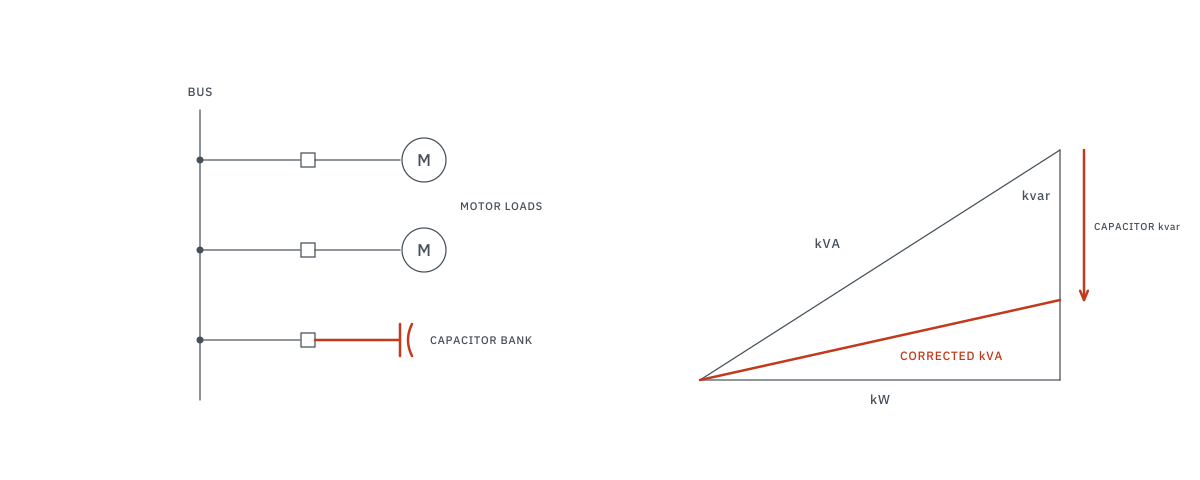
Voltage sags are among the most common power quality disturbances. A sag occurs when voltage drops below 90% of nominal for 0.5 cycles to 1 minute. The most common cause is a large motor starting on the same feeder - a 50HP motor can pull 400A for several seconds, dragging voltage down for everything else on that bus.
Protection: Properly sized feeders, dedicated circuits for large motor loads, voltage regulators, or UPS systems for sensitive equipment.
4. Swells / Overvoltage
The opposite of a sag - voltage rises above 110% of nominal. Less common but more damaging per event. A single-line-to-ground fault on a three-phase system can cause a swell on the unfaulted phases, potentially reaching 173% of nominal for delta-connected systems.
Protection: SPDs, voltage regulators, proper system grounding.
5. Waveform Distortion (Harmonics)
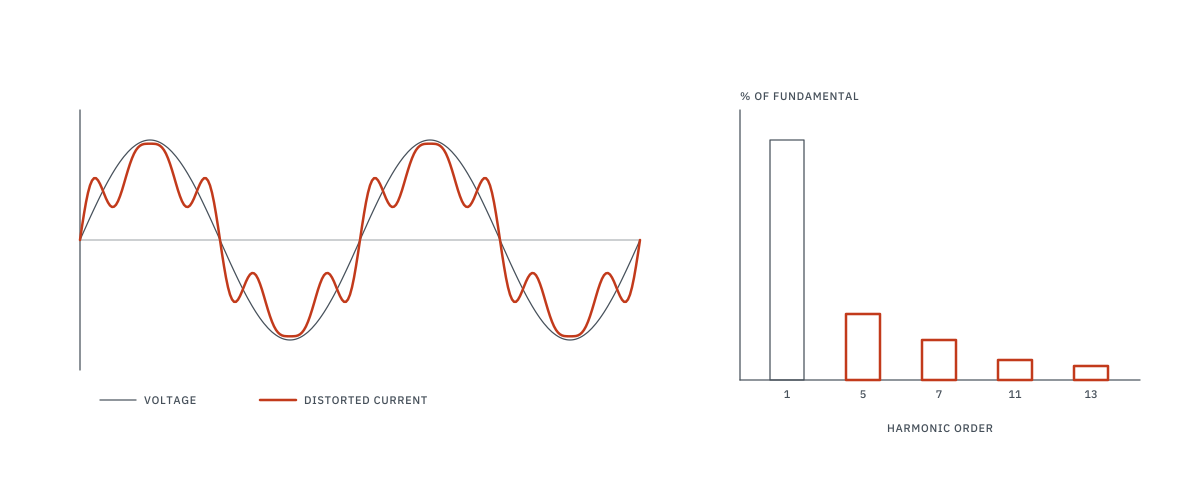
Modern electronic loads - VFDs, LED drivers, switched-mode power supplies, UPS systems - draw non-sinusoidal current. This distorts the voltage waveform. Total Harmonic Distortion (THD) above 5% starts causing problems: overheated transformers, nuisance breaker tripping, capacitor failure, and interference with sensitive controls.
Protection: Harmonic filters (passive or active), K-rated transformers (to tolerate the heating, not reduce distortion), proper system design to separate linear and non-linear loads.
6. Voltage Fluctuations (Flicker)
Rapid, repetitive voltage changes in the 0.1-7% range. The most visible symptom is light flicker - perceptible to the human eye at as little as 0.5% voltage change at certain frequencies. Arc furnaces and large welding machines are the primary industrial cause.
Protection: Dedicated feeders for fluctuating loads, static VAR compensators, or flicker-free LED drivers.
7. Frequency Variations
Normally the grid maintains 60 Hz ± 0.1 Hz. Frequency problems are rare on utility power but common on generator-supplied systems. An overloaded generator will drop below 60 Hz; an underloaded generator may surge above it. Equipment with synchronous motors, clocks, or timing-sensitive processes is most affected.
Protection: Proper generator sizing (see our generator sizing article), isochronous governor controls, and load management.
Cost of Power Problems
A 2001 study sponsored by the Electric Power Research Institute (EPRI) estimated that US businesses lose $104-$164 billion annually due to power interruptions and an additional $15-$24 billion due to other power quality problems, for a total of at least $119 billion per year (US dollars, US data).
Frequently Asked Questions
What are the seven types of power problems?
Using IEEE 1159 terminology, the seven groups are: transients, interruptions, sags/undervoltage, swells/overvoltage, waveform distortion (harmonics), voltage fluctuations (flicker), and frequency variations.
What is the most common power quality problem?
Voltage sags are among the most common power quality events. They typically last 0.5 to 30 cycles and can cause equipment shutdowns. See our harmonic analysis guide for waveform distortion solutions.
How do you protect equipment from power problems?
Solutions depend on the problem type: surge protectors for transients, UPS systems for interruptions and sags, voltage regulators for fluctuations, and harmonic filters for waveform distortion. See our energy storage guide for UPS and backup solutions.