Power Factor Correction: Stop Paying Utility Penalties Every Month
Your monthly hydro bill may already charge you for poor power factor, even without a separate line item: some distributors bill demand on kVA, which rises as power factor falls. If your facility runs motors, compressors, chillers, or VFDs, you could be paying thousands in unnecessary surcharges every year. Here's what power factor actually is, why the utility penalizes you for it, and how a capacitor bank can pay for itself.
What Is Power Factor?
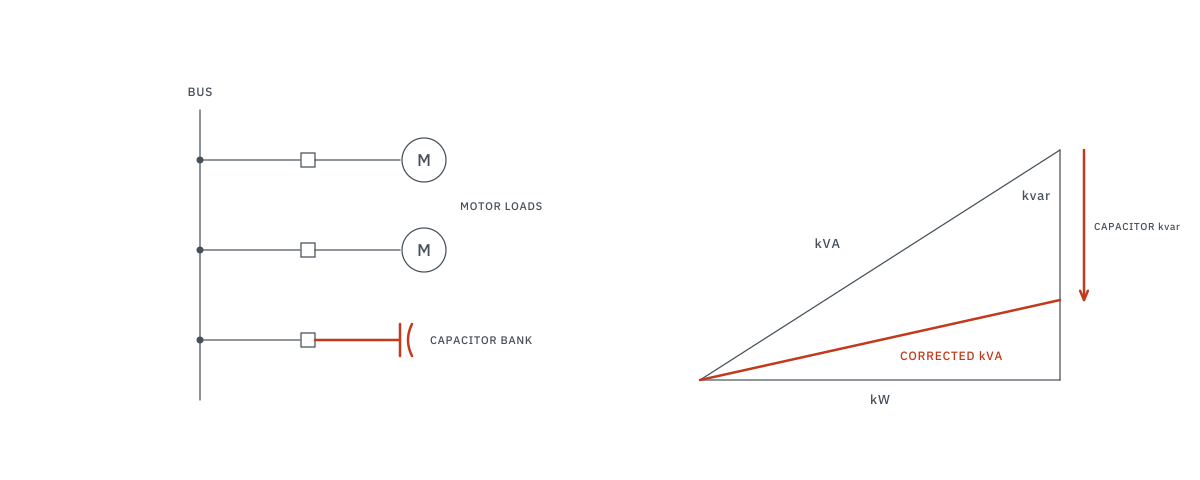
Power factor is the ratio of real power (kW - the power that actually does useful work) to apparent power (kVA - the total power the utility must deliver to your facility).
| Term | Unit | What It Represents | Analogy |
|---|---|---|---|
| Real Power | kW | Useful work - running motors, heating, lighting | The beer in your glass |
| Reactive Power | kVAR | Magnetizing current - sustains motor fields, transformer cores | The foam on top |
| Apparent Power | kVA | Total power the utility delivers (kW + kVAR combined) | The entire glass (beer + foam) |
| Power Factor | ratio | PF = kW / kVA (ratio, 0 to 1.0) | How much of the glass is beer |
PF = kW ÷ kVA
A power factor of 1.0 means 100% of the power delivered is doing useful work. A power factor of 0.70 means the utility is delivering 43% more current than you're actually using - and they charge you for it.
Why Do Utilities Penalize Low Power Factor?
When your power factor drops, the utility must supply more current to deliver the same real power. This extra current:
- Overloads their transformers and distribution lines
- Increases I²R losses in their cables (more heat, more waste)
- Reduces available capacity for other customers
- Forces them to upsize infrastructure sooner
Ontario distributors differ: Hydro One bills delivery on 90% of peak kVA when PF drops below 0.90, while Toronto Hydro bills its demand classes on kVA demand (not kW) - meaning low PF directly inflates your demand charges. Check your distributor's tariff.
Penalty Calculation Example
| Parameter | Before Correction | After Correction |
|---|---|---|
| Real Power (kW) | 500 kW | 500 kW |
| Power Factor | 0.72 | 0.96 |
| Apparent Power (kVA) | 694 kVA | 521 kVA |
| kVA Demand Charge (illustrative @$12/kVA) | $8,328/mo | $6,252/mo |
| Monthly Savings | $2,076/month = $24,912/year | |
How Power Factor Correction Works
The most common correction method is installing capacitor banks. Capacitors generate reactive power (kVAR) locally, offsetting the reactive power demanded by inductive loads (motors, transformers). This reduces the total current the utility needs to supply.
| Correction Method | Best For | Typical Cost |
|---|---|---|
| Fixed Capacitor Bank | Constant loads (fans, pumps running 24/7) | Lower cost |
| Automatic Capacitor Bank | Variable loads (manufacturing, commercial) | Moderate cost |
| Active Harmonic Filter | VFD-heavy facilities with harmonic issues | Higher cost |
| Synchronous Condenser | Large industrial plants (5MW+) | Highest cost |
Sizing the Capacitor Bank
To correct from PF1 to PF2, the required kVAR is:
kVAR = kW × (tan θ₁ - tan θ₂)
Example: Correct 500 kW from PF 0.72 to 0.96:
θ₁ = arccos(0.72) = 43.9° - tan(43.9°) = 0.964
θ₂ = arccos(0.96) = 16.3° - tan(16.3°) = 0.292
kVAR = 500 × (0.964 - 0.292) = 336 kVAR capacitor bank required
Installation Considerations
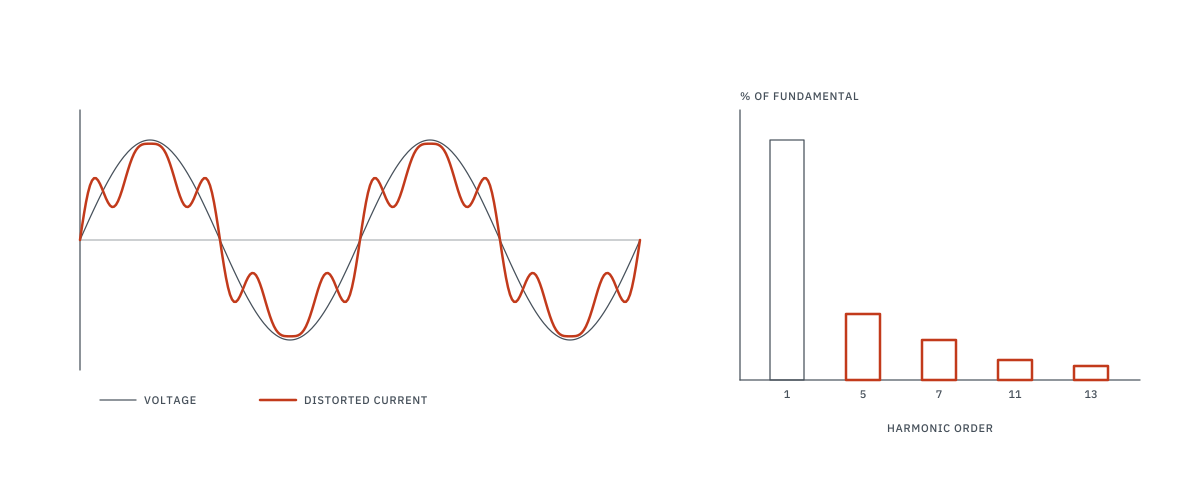
- Harmonic resonance: Capacitors + system inductance can create resonance at harmonic frequencies. Always perform a harmonic study before installing capacitor banks in facilities with VFDs or non-linear loads
- Leading power factor: Over-correction (PF > 1.0 leading) can cause voltage rise and generator instability. Target 0.95-0.97, not 1.0
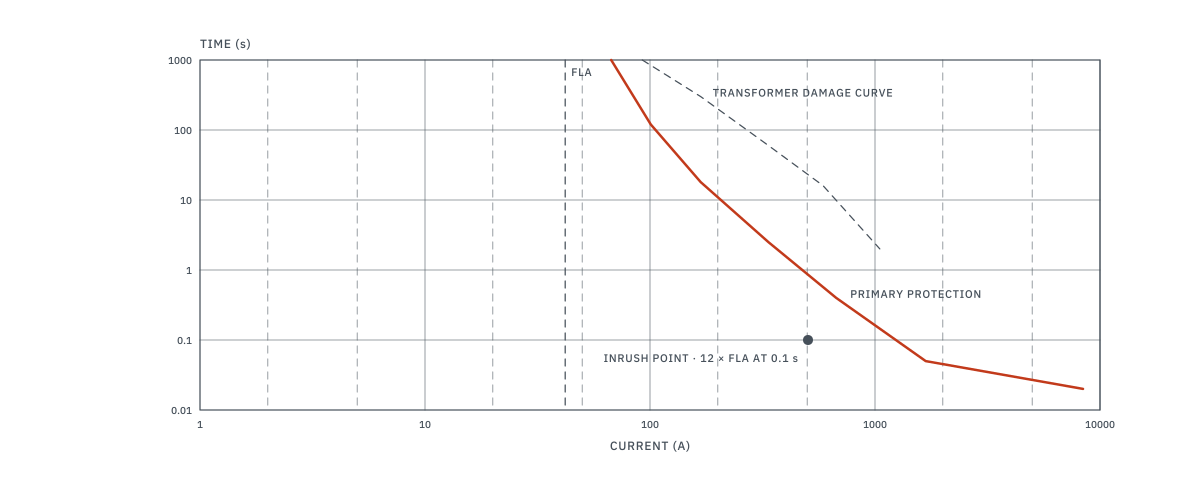
- Switching transients: Energizing large capacitor banks creates inrush currents and voltage transients. Use pre-insertion resistors or controlled switching contactors
- OESC Rule 26-222 (capacitors): A discharge circuit must reduce the residual voltage to 50 V or less within 1 min after disconnection (within 5 min for capacitors rated over 750 V); based on CSA C22.1:24, Rule 26-222
ROI - When Does It Pay For Itself?
| Facility Size | Typical Annual Penalty | Correction Cost | Payback Period |
|---|---|---|---|
| Small commercial (100 kW) | Lower; depends on tariff and measured PF | Small bank | Site-specific; confirm with a bill review |
| Medium industrial (500 kW) | Moderate; depends on tariff and measured PF | Automatic bank | Site-specific; confirm with a bill review |
| Large industrial (2 MW) | Higher; depends on tariff and measured PF | Larger automatic bank | Site-specific; confirm with a bill review |
Frequently Asked Questions
What is power factor?
The ratio of real power (kW) to apparent power (kVA). Low PF wastes utility capacity. Hydro One bills on 90% of peak kVA below 0.90; Toronto Hydro bills demand on kVA.
How much does a PF penalty cost?
It depends on facility size, tariff and measured power factor. See our load calculation guide for demand analysis.
How fast does correction pay for itself?
Payback depends on the tariff, measured power factor and bank cost; a bill review and a quote will show it. Watch for harmonic resonance issues.