Arc Flash Hazard Analysis: What Every Building Owner Needs to Know Before It's Too Late
An arc flash can reach about 19,400°C (35,000°F) - four times the surface temperature of the sun. It can kill a worker in milliseconds and destroy equipment worth hundreds of thousands of dollars. Ontario law requires employers to identify and mitigate this hazard. Here's what you need to know - and what you need to do.
What is an Arc Flash?
An arc flash is a sudden, explosive release of electrical energy through the air when current jumps between two conductors or from a conductor to ground. Unlike a shock (which requires physical contact), an arc flash creates an arc plasma fireball that can:
- Generate temperatures up to 35,000°F (19,400°C)
- Create a pressure blast wave of about 96 kPa (2,000 lb/ft²) - enough to throw a worker across a room
- Produce shrapnel from vaporized copper conductors expanding to 67,000 times their original volume
- Emit intense UV and IR radiation causing severe burns at distances of 3 m (10 ft) or more
Is an Arc Flash Study Legally Required?
In Ontario, the answer is effectively yes. While the Occupational Health and Safety Act (OHSA) doesn't use the phrase "arc flash study," it requires employers to:
OHSA Section 25(2)(h): Employers must "take every precaution reasonable in the circumstances for the protection of a worker."
CSA Z462 (Workplace Electrical Safety) is the standard the Ministry of Labour uses for guidance. It requires an arc flash risk assessment for any electrical equipment that may be serviced while energized.
If a worker is injured by an arc flash and no study was performed, the employer and those directing the work risk criminal liability under the Westray Bill (C-45) if criminally negligent, and corporate OHSA fines up to $2 million per offence.
IEEE 1584: How Incident Energy is Calculated
The industry standard for arc flash calculations is IEEE 1584-2018. The calculation determines the incident energy (in cal/cm²) at a given working distance from the arc source. This energy level dictates what PPE a worker must wear.
Key inputs to the calculation:
| Input Parameter | What It Means | Where to Get It |
|---|---|---|
| Available fault current (kA) | Maximum short-circuit current at the equipment | Utility data + short circuit study |
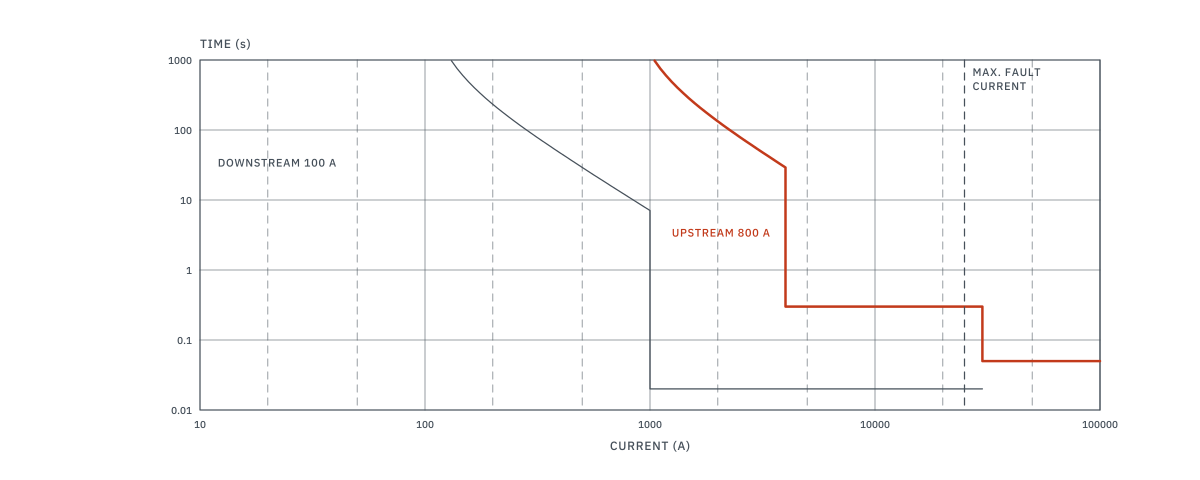
| Clearing time (cycles) | How fast the upstream breaker trips | Breaker TCC curves + coordination study |
| Working distance (mm) | Distance from the worker's face/chest to the arc | IEEE 1584 Table (typically 455-910mm) |
| Electrode configuration | VCB, VCBB, HCB, VOA or HOA (vertical/horizontal, box or open air) | Equipment type (panel, switchgear, MCC) |
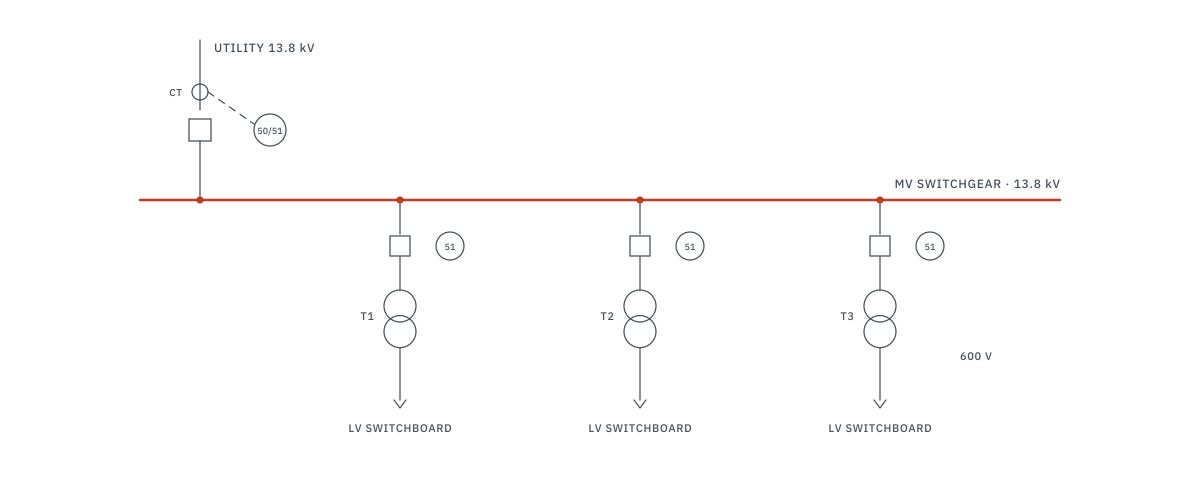
| System voltage (V) | Nominal voltage at the equipment | One-line diagram |
| Gap between conductors (mm) | Physical spacing inside the equipment | Equipment drawings or field measurement |
PPE Categories and Incident Energy Levels
| PPE Category | Minimum Arc Rating | Required PPE | Illustrative equipment (study-specific) |
|---|---|---|---|
| 1 | 4 cal/cm² | Arc-rated shirt/pants, arc-rated face shield, safety glasses, hard hat | 120V panels, small control panels |
| 2 | 8 cal/cm² | Arc-rated coveralls, face shield, balaclava | 208/240V panelboards, small MCCs |
| 3 | 25 cal/cm² | Arc flash suit (hood, jacket, pants), leather gloves | 600 V switchboards, large MCCs |
| 4 | 40 cal/cm² | Multi-layer arc flash suit, full hood, heavy gloves | Medium voltage switchgear |
| 5 (CSA only) | 75 cal/cm² | Arc flash suit system rated at least 75 cal/cm² | 600 V class switchgear and switchboards |
The goal of an arc flash study is NOT just to specify PPE - it's to engineer the hazard down. By upgrading breakers, adjusting trip settings, or adding zone-selective interlocking, incident energy can often be reduced substantially, lowering the arc rating of the PPE required.
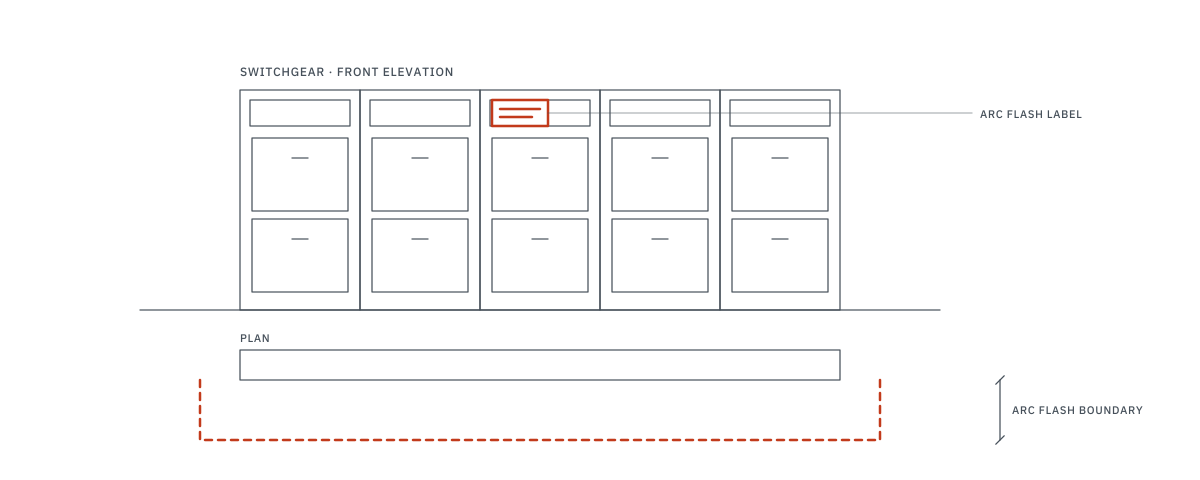
Arc Flash Boundaries
The study also calculates three critical safety boundaries around each piece of equipment:
- Arc Flash Boundary: The distance where incident energy falls to 1.2 cal/cm² - the onset of second-degree burns. Workers inside this boundary must wear rated PPE
- Limited Approach Boundary: Unqualified persons may cross only when escorted by a qualified person
- Restricted Approach Boundary: Shock hazard - requires specific training and PPE for shock protection
What a Complete Arc Flash Study Delivers
- Short circuit study: Available fault current at every bus and panel in the facility
- Coordination study: Verification that breakers trip in the correct sequence
- Incident energy calculations: cal/cm² at every piece of switchgear, panelboard, and MCC
- Arc flash labels: CSA Z462 warning labels for equipment likely to be worked on while energized
- Mitigation recommendations: Breaker upgrades, settings changes, and design modifications to reduce hazard levels
- PPE requirements table: Exactly what each worker needs to wear at each location
Common Misconceptions
- "We only work on de-energized equipment" - even verifying that equipment IS de-energized exposes workers to arc flash risk. Testing for absence of voltage is an energized task
- "Our building is too small for arc flash" - even a 200A, 208V residential panel can produce dangerous arc flash. Size doesn't determine risk; available fault current and clearing time do
- "We did a study 10 years ago" - CSA Z462 requires review at intervals not exceeding 5 years and an update whenever the electrical system changes
- "PPE is enough" - PPE is the last line of defense. A proper study focuses on engineering controls to reduce incident energy, not just specifying thicker suits
Frequently Asked Questions
Is an arc flash study legally required in Ontario?
Effectively yes. OHSA requires employers to take every reasonable precaution. The Ministry of Labour uses CSA Z462 for guidance.
What are the PPE categories?
Minimum arc ratings: Cat 1 4 cal/cm², Cat 2 8, Cat 3 25, Cat 4 40; CSA Z462 adds Cat 5 at 75 cal/cm².
How often should the study be updated?
Review at least every 5 years per CSA Z462, and update whenever the electrical system changes (new equipment, breaker modifications, utility supply changes).