Service Entrance Design: Utility Coordination That Makes or Breaks Your Project Timeline
The utility doesn't care about your construction schedule. A service entrance application can take weeks to several months - and if your load letter is wrong or your CT cabinet doesn't meet the LDC's metering requirements, you restart the clock.
Service Types in Ontario
| Service Type | Voltage | Typical Application | Metering |
|---|---|---|---|
| 120/240V 1Φ | 240V single-phase | Residential, small retail | Self-contained meter (200A max) |
| 120/208V 3Φ | 208V three-phase wye | Small commercial, offices | Self-contained or CT metering |
| 347/600V 3Φ | 600V three-phase wye | Industrial, large commercial | Self-contained (≤ 200A) or CT metering |
| 4.16kV / 13.8kV / 27.6kV | Medium voltage | Large industrial, campus | VT/CT metering, customer substation |
The Load Letter
Every service application starts with a load letter or load summary (P.Eng-sealed where the LDC or project requires it) specifying connected load, demand load (CEC Section 8), service size in amps, voltage, and a defined future-load allowance.
CT Cabinet & Metering
| Service Size | Metering Type | CT Ratio (example only; set by LDC) |
|---|---|---|
| ≤ 200A | Self-contained meter base | N/A |
| 201-400A | CT metering | 400:5 |
| 401-800A | CT metering | 800:5 |
| 801-1200A | CT metering (switchboard CT compartment) | 1200:5 |
| 1201-2000A | CT metering (switchboard CT compartment) | 2000:5 |
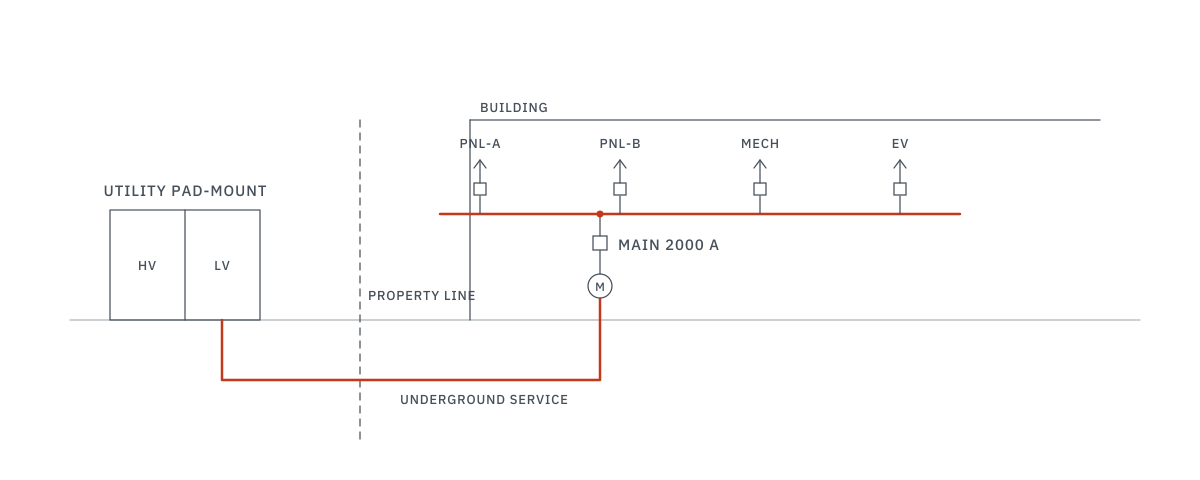
Critical: CT cabinets must meet the LDC's metering requirements (minimum size, CSA approval and, where listed, approved models). Hydro One, Toronto Hydro, and Alectra each have different requirements. Wrong CT cabinet = rip out and replace at your cost.
Service Conductor Sizing (CEC Rule 4-006)
Service conductors are sized for each project, not from a fixed table:
- Size from CEC Table 2 at the equipment termination temperature (normally 75 °C, Rule 4-006).
- Apply the Rule 4-004 corrections, derating for more than three conductors in a raceway, and the parallel-conductor rules.
- Conduit size follows from the fill for the stated insulation.
- Final sizing is confirmed by the engineer of record.
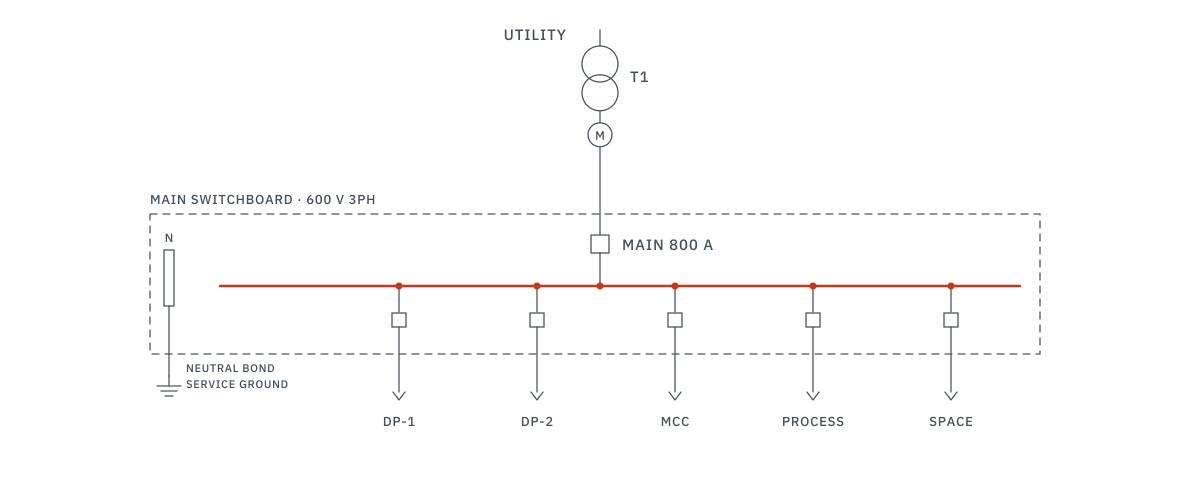
Grounding Electrode System (CEC Rule 10-102)
- Grounding conductor - sized per OESC Rule 10-114 and applicable tables
- Rod electrodes - where used, installed as required by OESC Rule 10-102, typically with spacing and interconnection requirements
- Water pipe bonding - coordinate with Section 10 equipotential bonding requirements for metallic piping systems
- Concrete-encased or in-situ electrodes - verify installation details against OESC Rule 10-102 and project conditions
Utility Coordination Timeline
| Phase | Indicative timing (varies by LDC and scope) | Action |
|---|---|---|
| Load letter submission | Week 0 | Load letter/summary (P.Eng-sealed where required) + site plan |
| Offer to connect | Weeks 4-8 | LDC reviews and issues conditions |
| Accept + pay contribution | Week 8-10 | Capital contribution if required |
| LDC installs transformer | Weeks 10-16 | Pad-mount or pole-mount transformer |
| Service connection | Week 16+ | After ESA inspection, LDC energizes |
Pro tip: Submit the load letter as early as possible - even before detailed design. Use conservative estimates. Easier to reduce later than increase after transformer is sized.
Not sure whether the project actually needs a service upgrade?
An industrial capacity study can identify whether the constraint is at the service—or at a transformer, switchboard, MCC, panel or feeder. See the complete factory expansion electrical-capacity planning guide.
Explore Industrial Electrical Capacity Studies →Frequently Asked Questions
What is the difference between 100A and 200A service?
100A is the older standard and still the OESC minimum for most homes (Rule 8-200: 80 m² or more of living area). 200A is common in new homes, supporting modern loads like EV chargers, electric ranges, and A/C.
When is a service upgrade required?
When calculated demand exceeds existing capacity. A load calculation (by a P.Eng or, for most homes, a licensed electrical contractor) determines if an upgrade is needed.
How long does utility coordination take?
Typically weeks to several months, depending on the LDC and scope. See our Toronto Hydro guide for LDC-specific timelines.