EV-Ready Wiring Requirements in Ontario: What Builders and Engineers Need to Know
With electric vehicle adoption accelerating across Ontario, proposed legislation and electrical code updates are shaping the future of EV-ready wiring in new construction. This article covers the current Ontario Building Code (OBC) landscape, the 2024 OESC (29th Edition) Section 86 requirements for EV Supply Equipment, proposed provincial legislation, municipal standards, and practical design considerations for electrical engineers and contractors.
Two Codes, Two Purposes
EV-ready wiring in Ontario is governed by two separate codes - a common source of confusion among builders and contractors:
| Code | Governs | Key Focus |
|---|---|---|
| Ontario Building Code (OBC) | What must be installed | Sets building requirements - the 2024 OBC has no EV-ready requirement; some municipalities have adopted EV-ready rules through zoning or green standards; proposed provincial legislation (Bill 52) would add one province-wide |
| 2024 OESC (29th Edition) | How it must be installed safely | Governs the safety of EVSE installations - wiring methods, overcurrent protection, grounding, load calculations. Effective May 1, 2025. |
Both codes must be followed. The OBC tells you what to build; the OESC tells you how to build it safely.
Proposed Provincial Legislation: Bill 52 (EV-Ready Homes Act)
Ontario Bill 52, the EV-Ready Homes Act (Electric Vehicle Charging), 2025, has been introduced in the Ontario Legislature and ordered for Second Reading, but has not yet been enacted into law as of May 2026. If passed, it would amend the Building Code Act to require the following in new residential construction with a garage, carport, or driveway:
| Proposed Requirement | Specification |
|---|---|
| Minimum panel capacity | 200 ampere panelboard minimum |
| Conduit | Minimum 27mm (1") trade size conduit equipped with a means to pull cables in, for future EVSE wiring |
| Junction box | 4-11/16 in. outlet box installed at the EV charging location |
| Gas barrier | Conduit and outlet box must provide an effective barrier against gas and exhaust fumes |
Important: While Bill 52 is not yet law at the provincial level, some municipalities have already adopted their own EV-ready requirements. For example, the City of Toronto Green Standard (TGS) has called for Level 2-capable energized outlets or EVSE in new residential parking spaces, but for applications made after June 2, 2026 (Bill 98) its interim checklist lists the EV measure as voluntary. Always check your local municipal zoning bylaws and green building standards, as they may impose requirements that exceed current provincial minimums.
2024 OESC (29th Edition) Section 86: EVSE Installation Requirements
When EV charging equipment is actually installed (not just "EV-ready" wiring), the 2024 OESC (29th Edition), effective May 1, 2025, governs the installation under Section 86. Key requirements include:
| Requirement | Details |
|---|---|
| Approved equipment | All EVSE must be approved for Canada - bearing a recognized Canadian certification or field-evaluation mark (e.g. CSA, cUL, cETL) - no uncertified equipment permitted |
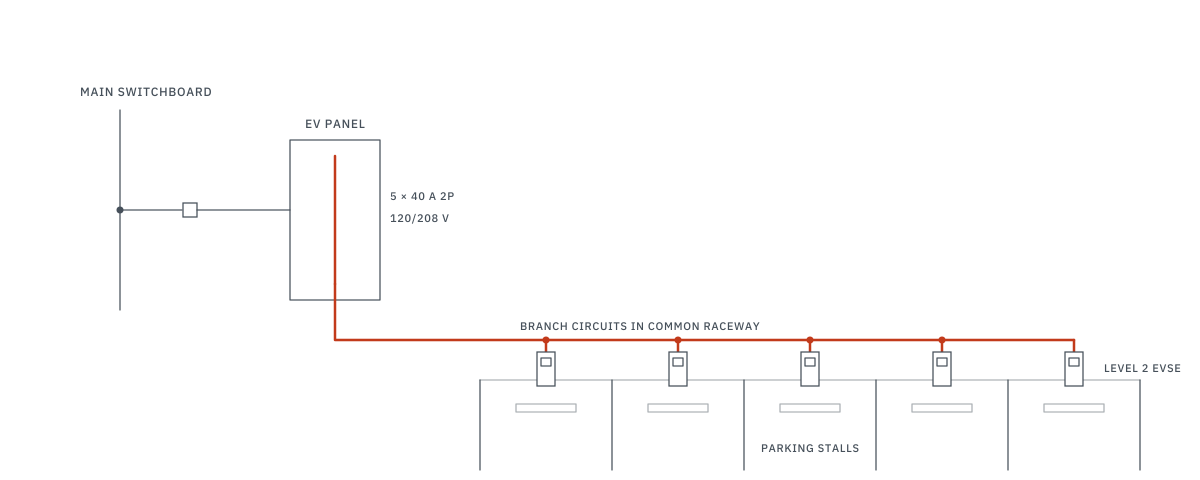
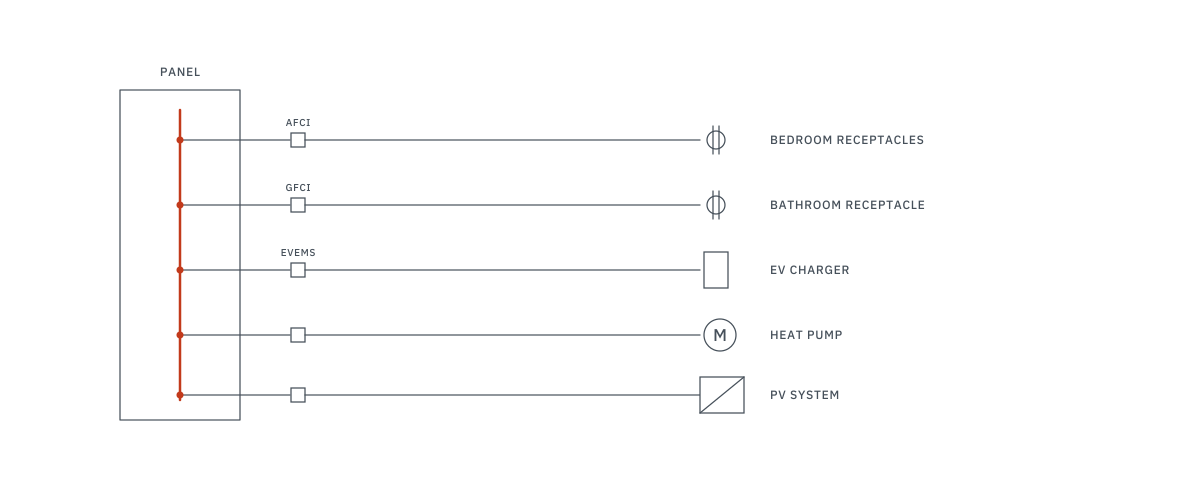
| Dedicated branch circuit | Each EVSE generally requires its own dedicated branch circuit. However, the code now recognizes Energy Management Systems (EMS) that may permit load-sharing arrangements under specific conditions. |
| Overcurrent protection | Sized per CEC rules - typically 40A breaker for a 32A continuous load (Level 2, 7.7 kW). Higher-rated EVSE (48A) requires a 60A breaker. |
| Conductor sizing | Must be selected per OESC conductor ampacity tables based on cable type, installation method, terminal temperature rating, and ambient conditions. For a typical 40A EVSE circuit, #8 AWG copper (90°C-rated) is common; for 48A EVSE on a 60A circuit, #6 AWG copper is typical. Always verify against applicable table for your specific installation. |
| GFCI protection | Class A GFCI required for EV charging receptacles (CSA 5-20R) installed outdoors within 2.5 m of finished grade (Rule 26-704 2)); indoor receptacles may also need GFCI depending on location |
| Disconnecting means | Requirements depend on the equipment voltage and rating. Refer to the applicable OESC disconnecting means rules for the specific EVSE installation. |
| Ventilation | Required for indoor charging only where the EV or EVSE is identified as requiring ventilation (Section 86 indoor-charging rules); it does not depend on the charging level |
Load Calculations: Rule 8-106
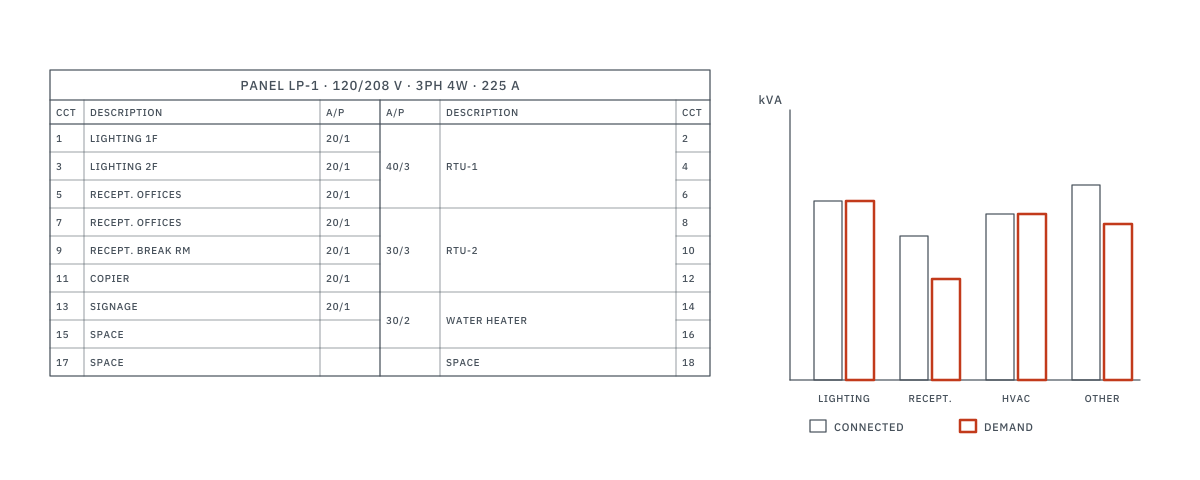
Adding an EV charger increases the electrical demand on a home's service. The 2024 OESC (29th Edition) adds the EVSE at 100% in the dwelling calculations (Rules 8-200 and 8-202) and allows demonstrated-load and EMS methods under Rule 8-106 to help engineers and contractors calculate whether the existing service can support an EVSE without an upgrade.
| Scenario | Typical Load | Approach |
|---|---|---|
| New home with 200A service | 7.7 kW (Level 2, 32A @ 240V) | Add the EVSE at 100% per Rule 8-200 - most 200A services can accommodate one EVSE without upgrade |
| Existing home with 100A service | 7.7 kW (Level 2) | Load calculation (or demonstrated load per Rule 8-106 8)) required - a service upgrade or an EMS may be needed |
| Multi-unit residential (MURB) | Multiple EVSE units | Without an EMS, EVSE loads are added at 100% (no diversity factor). Energy Management Systems (EMS) can reduce peak demand. |
Energy Management Systems (EMS)
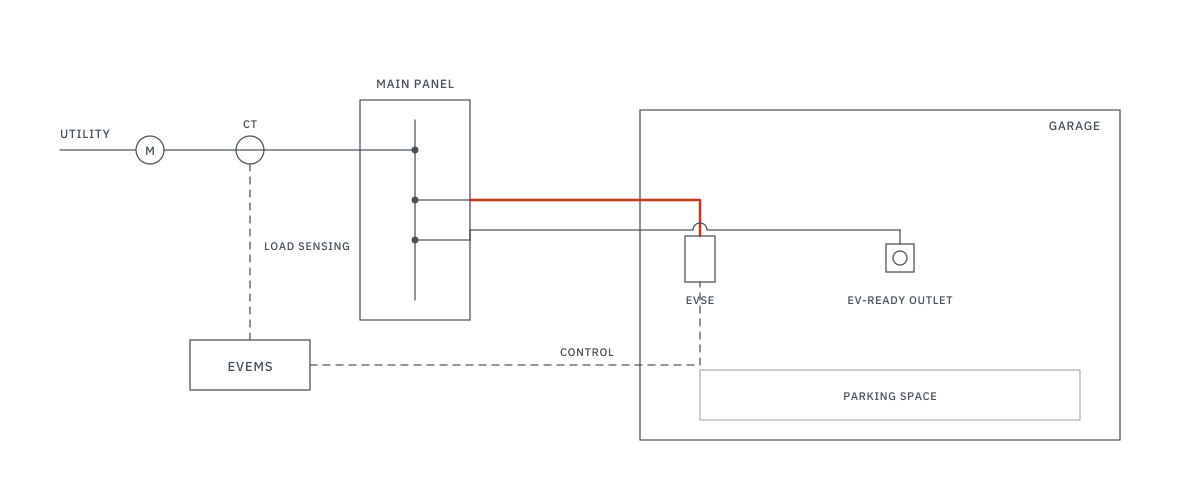
The 2024 OESC (29th Edition) formally recognizes Energy Management Systems (introduced as EVEMS in the 2018 code) as a code-compliant method to manage EV charging loads. An EMS can:
- Avoid service upgrades - by dynamically shedding non-essential loads during EV charging
- Enable load sharing - multiple EVs can share available capacity without exceeding service limits
- Reduce infrastructure costs - especially in multi-unit residential buildings and condominiums
- Future-proof - accommodate additional EVSEs as adoption grows without rewiring
EV Charging Levels Comparison
| Level | Voltage | Current | Power | Typical Charge Time | Application |
|---|---|---|---|---|---|
| Level 1 | 120V AC | 12A | 1.4 kW | 40-60 hours (full charge) | Emergency/overnight - standard outlet |
| Level 2 | 240V AC | 32A (typical) | 7.7 kW | 6-10 hours | Residential, workplace - most common |
| Level 2 (high-power residential) | 240V AC | 48A | 11.5 kW | 4-6 hours | Residential high-speed |
| DC Fast Charging | 200-1000V DC | Up to 500A | 50-350 kW | 15-45 minutes | Commercial, highway - requires utility coordination |
ESA Permit Requirements
All EV charger installations in Ontario require an ESA Notification of Work (electrical permit). This applies whether the work is performed by a Licensed Electrical Contractor (LEC) or a homeowner in their own primary residence.
- File a Notification of Work with ESA before beginning installation
- Request an ESA inspection when the work is ready - do not conceal any wiring before it is inspected
- ESA plan review is required, for example, where EVSE outside a single dwelling totals more than 20% of the service rating, for bi-directional EVSE over 12 kW, or for services of 400 A (three-phase) / 600 A (single-phase) or more
- Utility coordination required if service upgrade is needed - contact your local distribution company (e.g., Toronto Hydro, Alectra)
Frequently Asked Questions
Is EV-ready wiring required in Ontario new construction?
Bill 52 has been proposed but is not yet law. The 2024 OESC Section 86 covers EVSE installations, and some municipalities, such as Toronto, have adopted EV-ready provisions (Toronto's green-standard EV measure has been voluntary since June 2026).
What size circuit do I need for a Level 2 EV charger?
Most Level 2 chargers require a 40A or 50A, 240V dedicated circuit. See our plug and receptacle guide for connector types.
Do I need an ESA permit for EV charger installation?
Yes. All EVSE installations in Ontario require an ESA electrical permit. If you hire someone, by law it must be a Licensed Electrical Contractor; homeowners may do the work in their own home and file the notification themselves.