Solar PV System Design & Net Metering: The Ontario Engineer's Guide
Ontario's net metering program lets building owners offset their hydro bill with rooftop solar - but the electrical design has to satisfy CEC Section 64, ESA inspection, and utility interconnection requirements simultaneously. Here's the engineering behind a code-compliant PV installation.
System Architecture: Grid-Tied PV
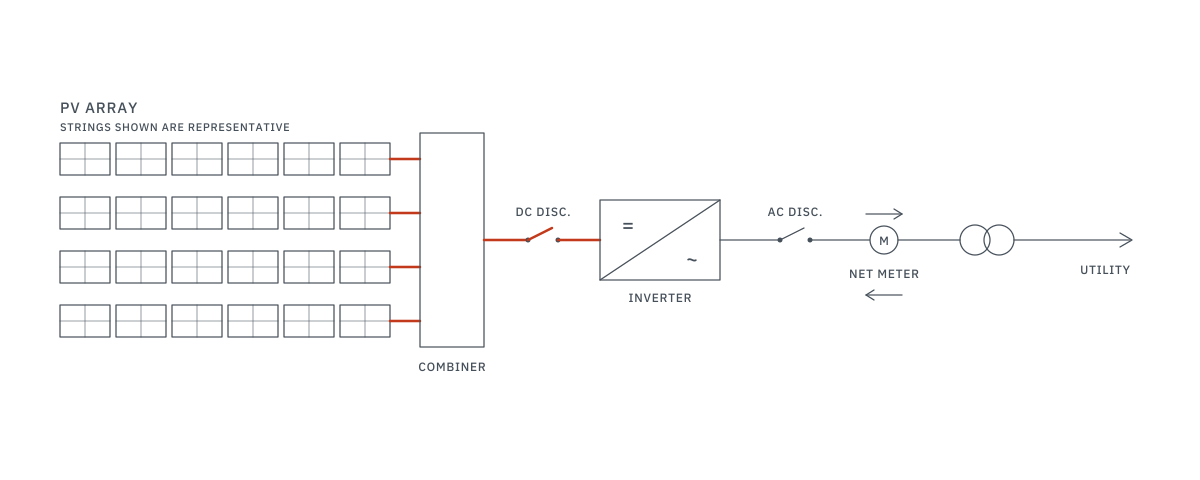
The vast majority of Ontario commercial PV installations are grid-tied without battery storage. The system components:
| Component | Function | Key Specification |
|---|---|---|
| PV Modules | Convert sunlight to DC electricity | Typically 400-550W monocrystalline, Voc 40-50V per module |
| String Inverter | Convert DC to AC (grid-synchronous) | Must be certified for Canada to CSA C22.2 No. 107.1; anti-islanding per CSA C22.3 No. 9 / IEEE 1547 |
| AC Disconnect | Visible, lockable disconnect for utility access | Required by utility - readily accessible to the LDC and lockable open; location per LDC |
| DC Disconnect | Isolate PV array from inverter | Disconnecting means required by the applicable Section 64 PV disconnect rules and equipment instructions |
| Revenue Meter | Bidirectional meter tracking import/export | Provided by LDC (Local Distribution Company) |
| Rapid Shutdown | De-energize rooftop conductors for firefighter safety | CEC Rule 64-218 - within 30 seconds, to 30V for conductors more than 1 m from the array |
CEC Section 64 - Solar Photovoltaic Systems
Section 64 is the dedicated CEC section for PV installations. Key rules:
| CEC Rule | Requirement |
|---|---|
| 64-206 | Ampere rating of PV source circuits - calculated from the module nameplate Isc (short circuit current); limited by the module's marked fuse rating or the conductor ampacity |
| 64-214 | Overcurrent protection for PV source circuits - maximum fuse rating per module manufacturer datasheet |
| 64-112 / Section 84 | PV system output connected to the supply side of the service disconnect requires utility approval |
| 64-112 | Interactive point of connection requirements for utility-interactive PV systems, including load-side connection limits |
| 64-210 | PV wiring method requirements for system conductors |
| 64-218 | Rapid shutdown - PV conductors more than 1 m from the array must be reduced to 30V within 30 seconds of initiation |
The 120% Rule (CEC Rule 64-112)
The sum of the PV backfeed breaker rating and the main breaker rating shall not exceed 120% of the busbar rating (125% in dwelling units).
Example: 200A busbar panel - 200A × 1.2 = 240A maximum; 240A - 200A main = 40A maximum PV backfeed breaker
At 240V single-phase: 40A ÷ 1.25 = 32A continuous × 240V ≈ 7.7 kW maximum inverter output
If the PV system exceeds this limit, options include:
- Upgrade the busbar - install a higher-rated panel
- Supply-side connection - connect PV on the line side of the service disconnecting means (Rule 64-112; requires utility approval)
- Line-side tap - connect directly to the consumer's service conductors (complex; engineered design recommended)
Net Metering in Ontario
| Parameter | Detail |
|---|---|
| Program | Ontario Net Metering (O. Reg. 541/05) |
| Maximum size | No kW cap in O. Reg. 541/05 (generation must be primarily for own use; LDC connection limits apply) |
| Meter type | Bidirectional - credits exported kWh at the same rates as consumption (not demand charges) |
| Credit rollover | Excess credits roll forward for 12 months, then reset to zero |
| Eligible LDCs | Hydro One, Toronto Hydro, Alectra and other Ontario LDCs (a few remote and on-reserve distributors are exempt) |
| Application | Submit to your LDC with single-line diagram (P.Eng-sealed where required, e.g. Toronto Hydro CIA projects over 12 kW), ESA notification |
Utility Interconnection Process
- Step 1: Pre-application - confirm service capacity and transformer sizing with LDC; projects over 12 kW generally need a Connection Impact Assessment
- Step 2: Engineering design - single-line diagram (P.Eng-sealed where the LDC requires it)
- Step 3: ESA permit - file notification with Electrical Safety Authority
- Step 4: Installation and ESA inspection
- Step 5: LDC meter exchange - install bidirectional meter
- Step 6: Authorization to connect (ATC) - LDC approves grid connection
Inverter Sizing
| Parameter | Rule |
|---|---|
| DC/AC ratio | Typically 1.1-1.3 (e.g., 13 kW DC array - 10 kW inverter) |
| Input voltage window | String Voc (at lowest temp) must be within inverter max Vdc rating |
| MPPT range | String Vmp must fall within inverter MPPT voltage window at all operating temperatures |
| Anti-islanding | Inverter must cease export within 2 seconds of grid loss (IEEE 1547 / CSA C22.2 No. 107.1) |
Frequently Asked Questions
What is net metering in Ontario?
Net metering allows solar PV system owners to export excess electricity to the grid and receive credits on their utility bill. The program is available through local distribution companies with no kW cap in O. Reg. 541/05, provided generation is primarily for the customer's own use.
What is the 120% rule for solar PV?
CEC/OESC Rule 64-112 covers interactive point of connection requirements, including the common 120% busbar calculation for load-side PV connections. For a 200A panel with a 200A main, the maximum solar breaker is often 40A (200A × 120% = 240A, minus 200A main = 40A; 50A in dwelling units, where 125% applies), subject to the exact equipment ratings. See our service entrance guide for panel rating details.
Do I need a P.Eng stamp for a solar PV installation in Ontario?
Engineered drawings are commonly required for commercial or complex solar PV installations, especially where utility interconnection, service changes, structural coordination, or ESA plan review apply. See our P.Eng stamp requirements guide for details.