Electrical Plug & Receptacle Types: The Complete World & NEMA Guide
From the standard North American 5-15R to the UK's Type G and Australia's Type I - this guide covers every plug type you'll encounter as an engineer, traveler, or contractor. Plus: NEMA configurations for dedicated circuits, CEC requirements, and the voltage/frequency map of the world.
Major International Plug Types
Common international references group plugs into lettered types from A through O. Below are the major groups you will encounter. Note: Voltage and frequency vary by country - always verify the local supply before connecting equipment.
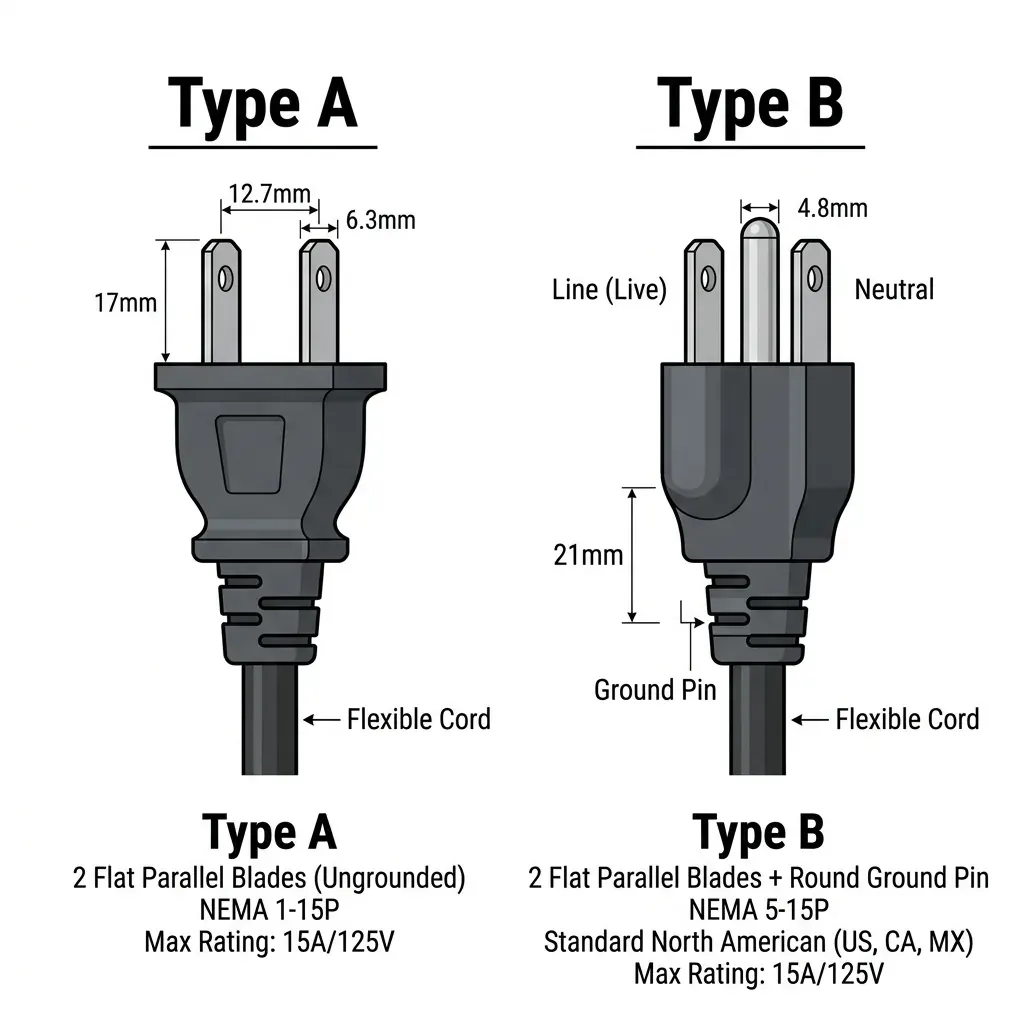
Type A & B - North America, Japan
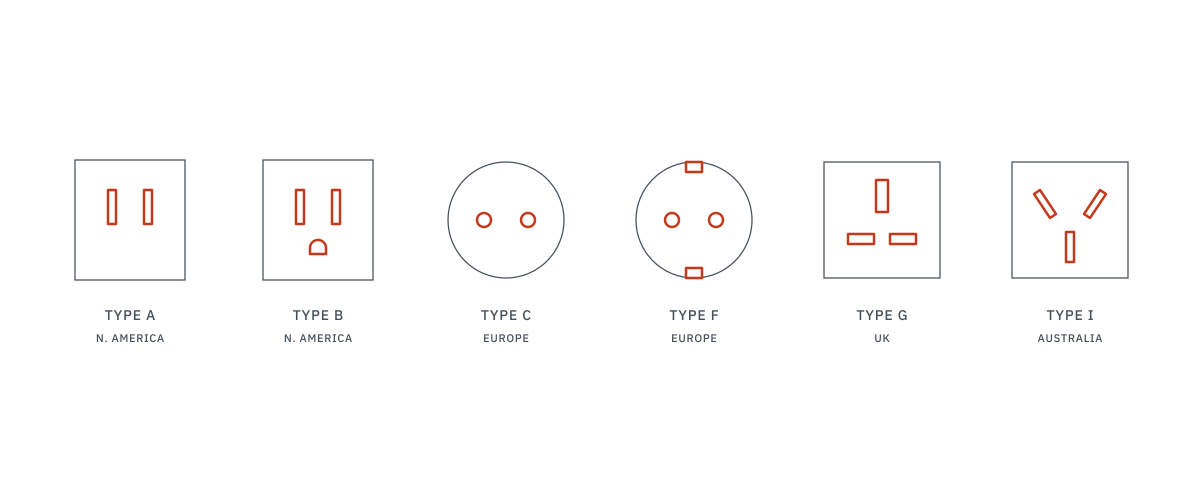
Type A: 2 flat parallel blades, ungrounded. Type B: adds a round ground pin. Used in Canada, USA, Mexico, Japan, Central America. In Canada, all new installations require grounded Type B (NEMA 5-15R) per CEC. Japan uses the same shape but at 100V. See our CEC Receptacle Layout Guide for spacing rules.
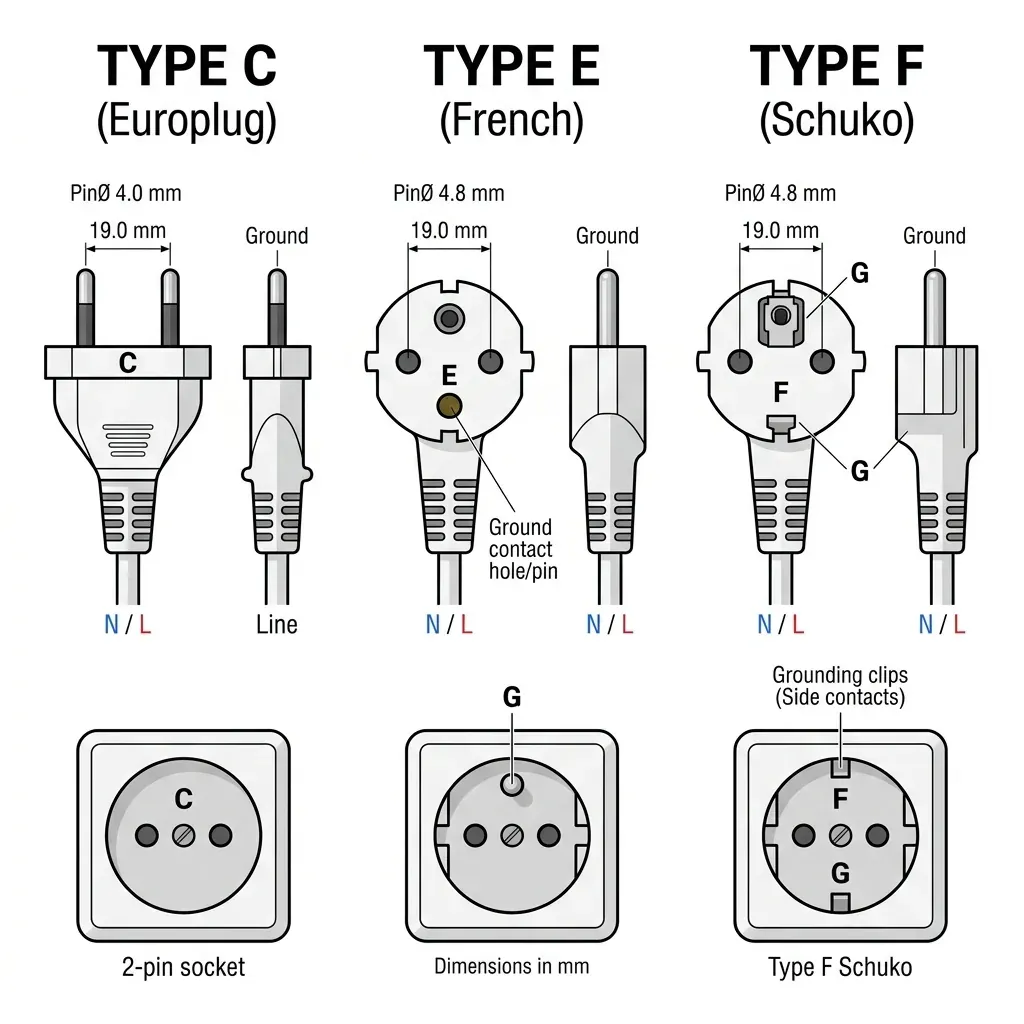
Type C, E & F - Continental Europe
Type C (Europlug): 2 round pins, ungrounded, rated 2.5A max - for low-power devices only. Type E (French): grounded via a pin in the socket. Type F (Schuko): grounded via side clips. Used across most of the EU, Russia, and parts of Asia/South America. For a detailed comparison with North American standards, see our IEC vs. North American Standards guide.
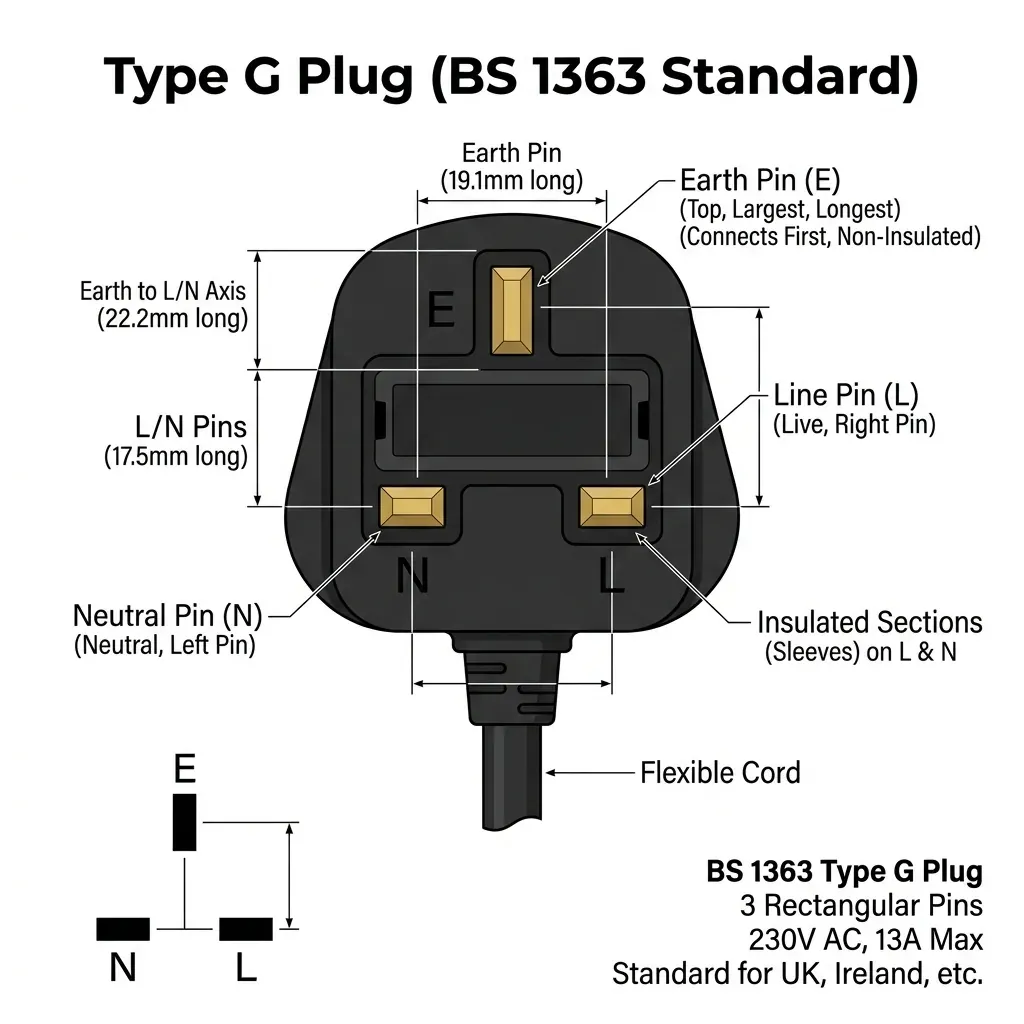
Type G - United Kingdom & Former British Regions
3 rectangular pins in a triangle. Unique feature: each plug contains its own cartridge fuse (typically 3A or 13A), providing per-appliance overcurrent protection. Grounded. Used in UK, Ireland, Singapore, Malaysia, Hong Kong, UAE, and many former British territories. 230V, 50 Hz.
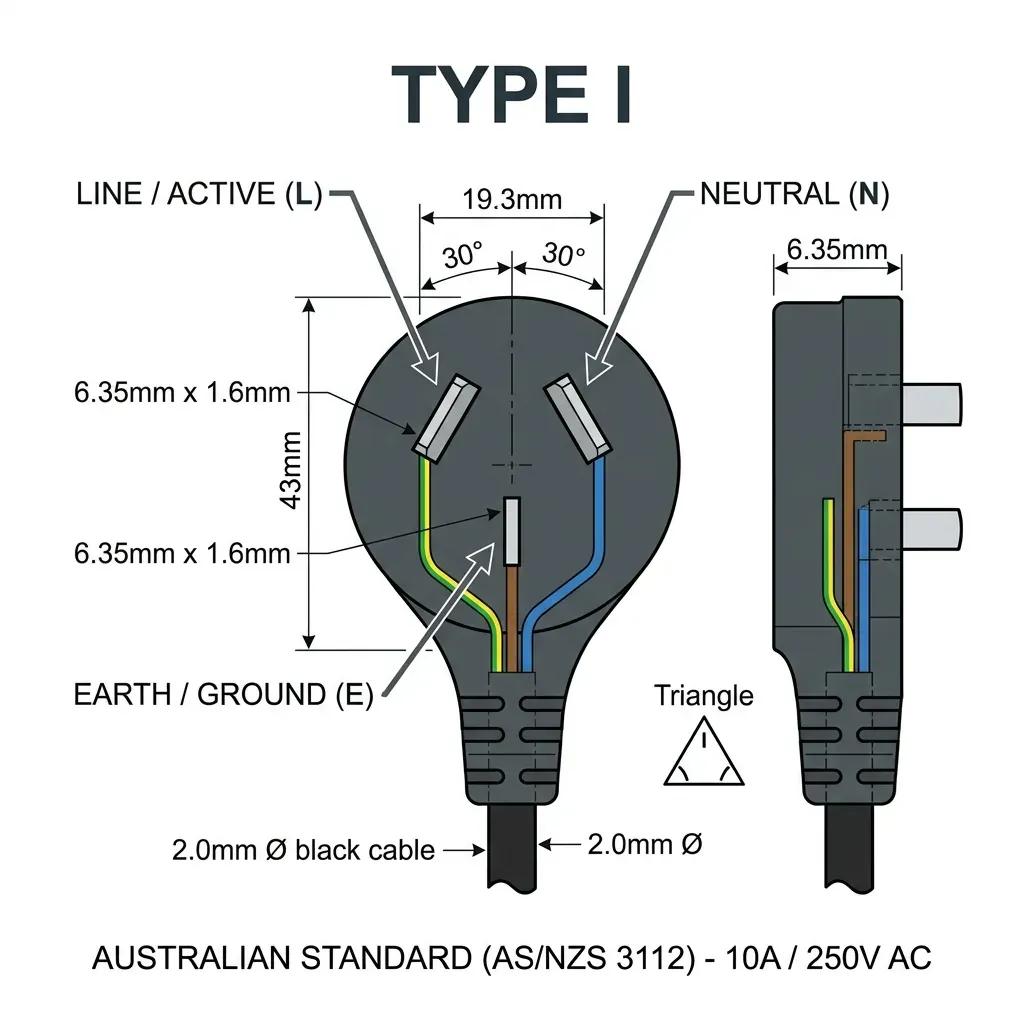
Type I - Australia, New Zealand, China, Argentina
2 angled flat blades in a V-shape plus a vertical ground pin. Grounded. 230V 50 Hz in Australia/NZ; 220V 50 Hz in China. Argentina uses a variant with inverted polarity.
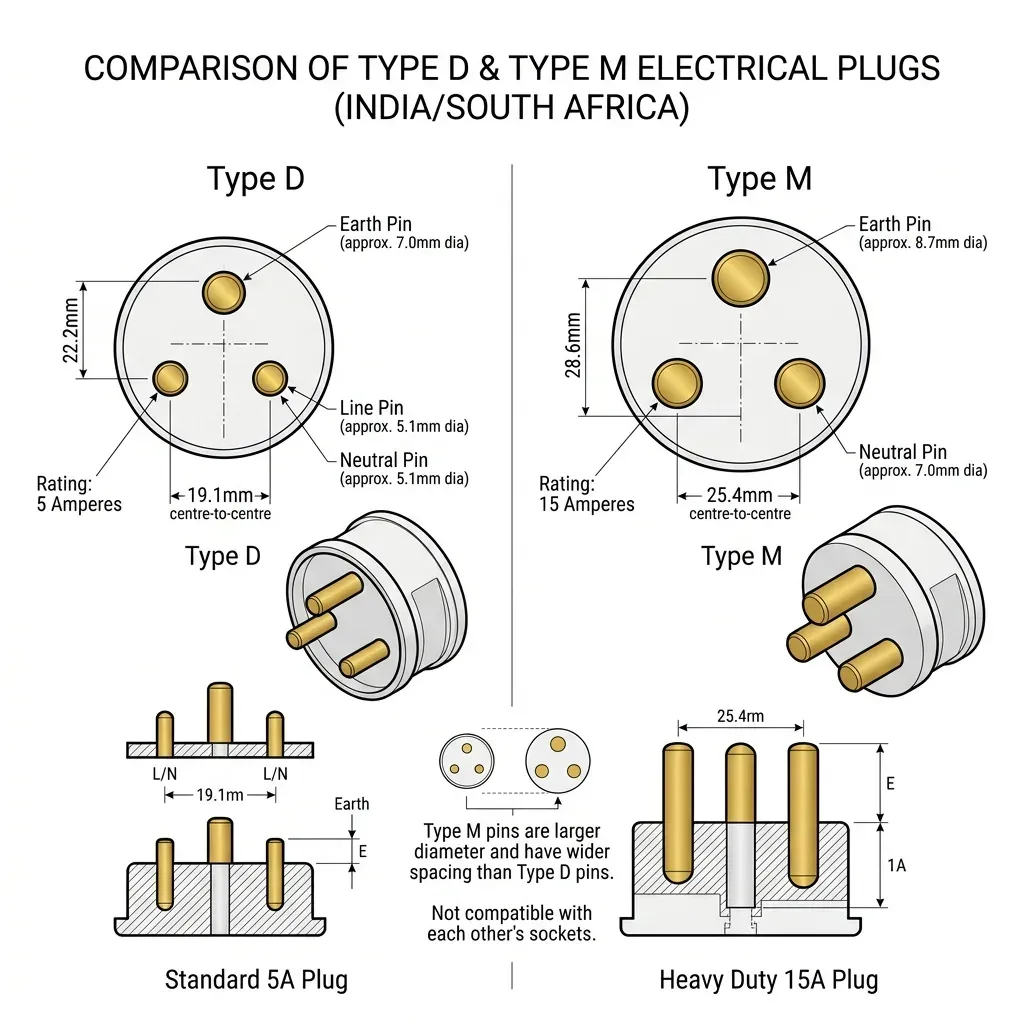
Type D & M - India, South Africa, Eswatini
Type D (BS 546, 5A): 3 large round pins in a triangle - the lighter-duty variant for general outlets. Type M (BS 546, 15A): same geometry but larger pin diameter and wider spacing, used for heavy-duty appliances (A/C, heaters). Both are grounded. Type M remains common in South Africa and Eswatini. 230V, 50 Hz.
Other Regional Types
| Type | Regions | Key Feature |
|---|---|---|
| H | Israel | 3 pins (V-shape or round), grounded, 230V 50 Hz |
| J | Switzerland, Liechtenstein | 3 round pins (offset ground), grounded, 230V 50 Hz |
| K | Denmark, Greenland | 3 round pins, grounded, 230V 50 Hz |
| L | Italy, Chile | 3 round pins (inline), grounded, 230V 50 Hz |
| N | Brazil (127/220V, 60 Hz); South Africa (230V, 50 Hz) | 3 round pins, grounded - IEC 60906-1 based |
| O | Thailand | 3 round pins, grounded, 230V 50 Hz |
Canada uses Type B (NEMA 5-15R / 5-20R grounded receptacles). Type A (ungrounded) exists in older homes but is not permitted for new installations per CEC.
World Voltage & Frequency Reference
Plug type alone does not determine voltage or frequency. Always verify the local electrical supply specifications.
| Region | Voltage | Frequency | Common Plug Types |
|---|---|---|---|
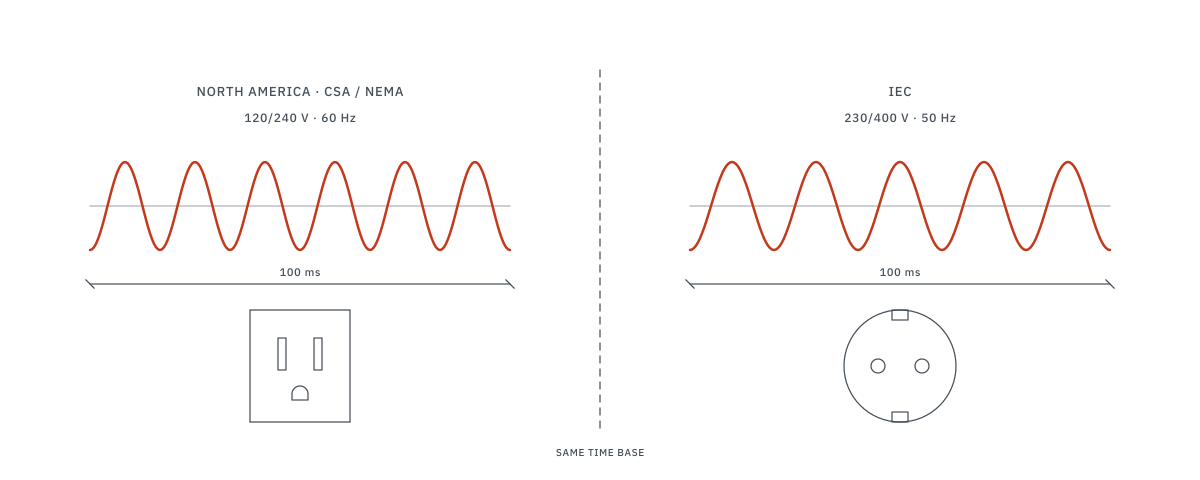
| North America (Canada, USA, Mexico) | 120V / 240V | 60 Hz | A, B |
| Continental Europe | 220-240V | 50 Hz | C, E, F |
| United Kingdom | 230V | 50 Hz | G |
| Australia / New Zealand | 230V | 50 Hz | I |
| Japan | 100V | 50/60 Hz | A, B |
| China | 220V | 50 Hz | A, C, I |
| India | 230V | 50 Hz | C, D, M |
| Brazil | 127/220V | 60 Hz | C, N |
| Middle East | 220-240V | 50 Hz | C, G (varies) |
| Africa | 220-240V | 50 Hz | C, D, G, M, N (varies) |
NEMA Configurations - North American Standard
In North America, the National Electrical Manufacturers Association (NEMA) defines plug and receptacle configurations. The naming convention follows the format: [Series]-[Amperage][P or R].
- P = Plug (male connector)
- R = Receptacle (female outlet)
- L prefix = Locking (twist-lock) configuration
Standard (Straight Blade) NEMA Configurations
| NEMA | Voltage | Amps | Poles/Wires | Ground | Common Application |
|---|---|---|---|---|---|
| 1-15 | 125V | 15A | 2P / 2W | No | Legacy ungrounded outlets (older homes) |
| 5-15 | 125V | 15A | 2P / 3W | Yes | Standard household outlet - the most common receptacle in Canada |
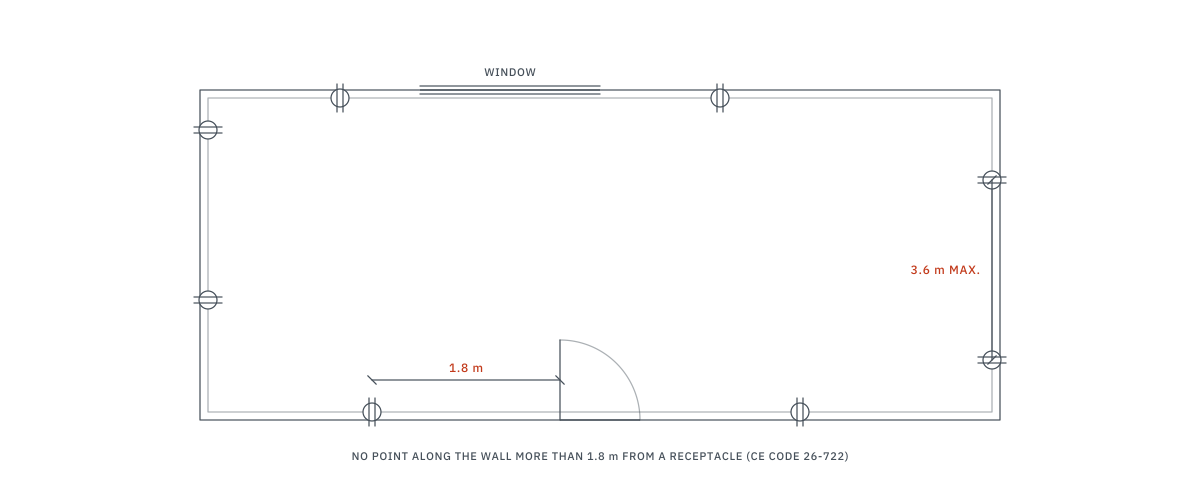
| 5-20 | 125V | 20A | 2P / 3W | Yes | 20 A circuits; kitchen counters may use 5-15R split or 5-20R (Rule 26-722) |
| 6-15 | 250V | 15A | 2P / 3W | Yes | Window A/C units, small equipment |
| 6-20 | 250V | 20A | 2P / 3W | Yes | Large A/C units, power tools, server equipment |
| 6-50 | 250V | 50A | 2P / 3W | Yes | Welders, some EV chargers |
| 10-30 | 125/250V | 30A | 3P / 3W | No | Legacy dryer outlet (no separate ground) |
| 10-50 | 125/250V | 50A | 3P / 3W | No | Legacy range outlet (no separate ground) |
| 14-30 | 125/250V | 30A | 3P / 4W | Yes | Electric clothes dryer - current standard |
| 14-50 | 125/250V | 50A | 3P / 4W | Yes | Electric range, EV charging (Level 2) - current standard |
CEC Note: NEMA 10-series (3-wire, no separate ground) receptacles are no longer permitted for new installations. New dryer circuits require a 14-30R and new free-standing electric range circuits a 14-50R (Rule 26-744), with exemptions such as built-in cooktops and ovens.
Locking (Twist-Lock) NEMA Configurations
Locking receptacles use curved blades that twist into place, preventing accidental disconnection. Common in commercial, industrial, and generator applications.
| NEMA | Voltage | Amps | Poles/Wires | Common Application |
|---|---|---|---|---|
| L5-20 | 125V | 20A | 2P / 3W | Commercial equipment, UPS systems |
| L5-30 | 125V | 30A | 2P / 3W | Portable generators, RV parks |
| L6-20 | 250V | 20A | 2P / 3W | Server racks, data centers |
| L6-30 | 250V | 30A | 2P / 3W | Industrial equipment, welders |
| L14-20 | 125/250V | 20A | 3P / 4W | Portable generators (smaller) |
| L14-30 | 125/250V | 30A | 3P / 4W | Portable generators (standard - most common) |
| L21-30 | 120/208V 3~ | 30A | 4P / 5W | Three-phase commercial, data centers |
CEC Dedicated Circuit Requirements
Typical dwelling-unit appliance circuits and receptacle configurations are listed below; the governing requirements are in CEC Section 26 and the appliance rating, so confirm against the current OESC:
| Appliance | NEMA Receptacle | Circuit | CEC Reference |
|---|---|---|---|
| Electric range / oven | 14-50R | 40A or 50A, 240V | Rule 26-744 |
| Electric dryer | 14-30R | 30A, 240V | Rule 26-744 |
| Dishwasher | 5-15R or 5-20R | 15A or 20A, 120V | CEC Section 26 |
| Garburator (disposal) | 5-15R (split or dedicated) | 15A, 120V | CEC Section 26 |
| Microwave (built-in) | 5-20R | 20A, 120V | CEC Section 26 |
| Refrigerator | 5-15R | 15A, 120V (dedicated recommended) | CEC Section 26 |
| Washer | 5-20R | 20A, 120V | CEC Section 26 |
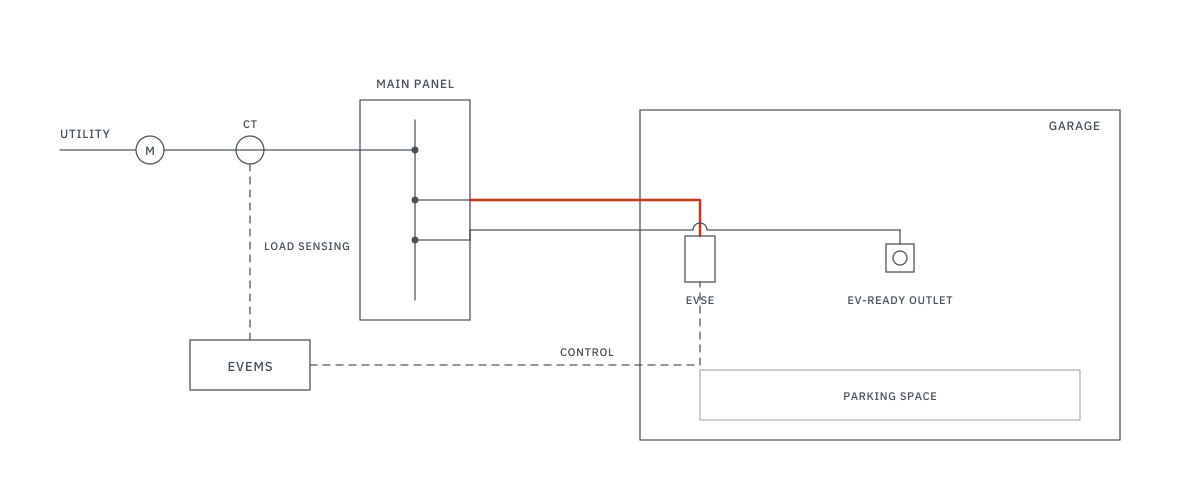
| EV charger (Level 2) | 14-50R or hardwired | 40A-50A, 240V | Section 86 - see our EV-Ready guide |
| Central A/C | Hardwired or 6-20R | Per nameplate | Equipment nameplate and CEC Section 26 |
| Bathroom receptacle | 5-15R or 5-20R (Class A GFCI) | 15A or 20A, 120V | Rule 26-704 |
Key Engineering Considerations
- Voltage mismatch = equipment damage. A 120V device plugged into 240V will be destroyed. Always verify voltage before connecting.
- Adapters converters. A plug adapter changes shape only - it does not convert voltage. A transformer/converter is needed for voltage conversion.
- Frequency matters for motors. A 60 Hz motor running on 50 Hz will run slower and may overheat. Electronic devices with switch-mode power supplies (laptops, phones) generally handle both.
- Tamper-resistant (TR) receptacles are required in dwelling units for 5-15R and 5-20R receptacles per Rule 26-706, with limited exceptions.
- Outdoor receptacles need wet-location cover plates (Rule 26-708) and Class A GFCI protection within 2.5 m of finished grade (Rule 26-704).
Frequently Asked Questions
What plug type does Canada use?
Canada uses Type B plugs (NEMA 5-15 grounded). Type A (ungrounded) exists in older homes but is not permitted for new installations per the Canadian Electrical Code. For kitchen counters, CEC Rule 26-722 allows 5-15R split or 5-20R receptacles.
What is the difference between NEMA 14-30 and 14-50?
NEMA 14-30 is a 30A, 125/250V receptacle for electric dryers. NEMA 14-50 is a 50A, 125/250V receptacle for electric ranges and Level 2 EV chargers. Both are 4-wire (3-pole + ground).
Can I use a plug adapter to convert voltage?
No. A plug adapter only changes the physical shape. It does not convert voltage. Plugging a 120V device into a 240V outlet through an adapter will destroy the device. A voltage converter or transformer is required.
What is a NEMA locking receptacle?
A locking (twist-lock) receptacle uses curved blades that twist into place, preventing accidental disconnection. Common in generator installations, industrial equipment, and data centers. Designated with an "L" prefix (e.g., L14-30).
What is the difference between Type C, E, and F European plugs?
Type C (Europlug) has 2 round pins and is ungrounded, rated only 2.5A. Type E (French) adds grounding via a pin in the socket. Type F (Schuko/German) adds grounding via side clips. See our IEC vs. North American Standards comparison for more detail.