AFCI Requirements: The 2024 CEC Changes That Affect Every Residential Project
Arc faults are a recognized cause of residential electrical fires. AFCI protection, first required for bedrooms, was expanded to most dwelling-unit receptacle circuits in the 2015 edition; the 2024 OESC keeps that scope. Here's what applies and how to design for it.
What Is an Arc Fault?
An arc fault is an unintended electrical discharge - a spark jumping across a gap in damaged wiring, a loose connection, or a nail driven through a cable. Unlike overloads or short circuits (which trip standard breakers), arc faults generate low-level, intermittent energy that's hot enough to ignite wood and insulation but too small for conventional overcurrent protection to detect.
AFCI Types
| Type | Detects | CEC Requirement |
|---|---|---|
| Combination AFCI (CAFCI) | Both series and parallel arc faults | Required for all new AFCI-protected circuits - this is the standard |
| Branch/Feeder AFCI | Parallel (line-to-line/line-to-ground) arcs only | Older type - not acceptable as the sole protection since the 2015 edition (see ESA Bulletin 26-29-6 for older panels) |
| AFCI Outlet (receptacle) | Downstream arc faults | Permitted at the first outlet under Rule 26-658 b) if the run to it is metal raceway, armoured cable or conduit/tubing; also on circuit extensions |
CEC Rule 26-658: Where AFCI Is Required
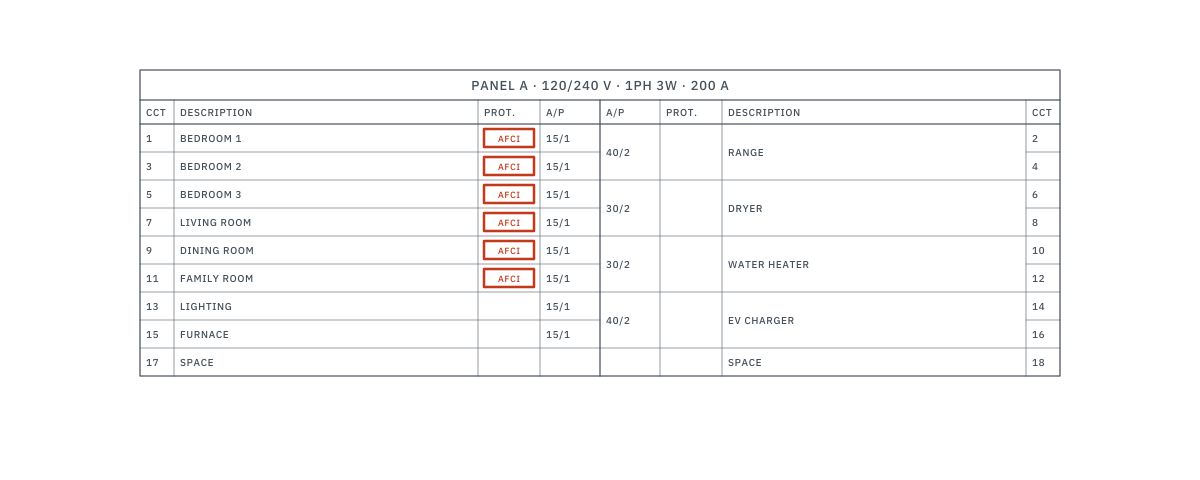
The 2024 Ontario Electrical Safety Code (OESC) requires combination-type AFCI protection for dwelling-unit branch circuits supplying 125 V receptacles rated 20 A or less, subject to listed exceptions:
| Circuit Type | AFCI Required? | Notes |
|---|---|---|
| Bedrooms | Yes | Branch circuits supplying 125 V receptacles rated 20 A or less |
| Living rooms, dining rooms, dens | Yes / verify | Applies when the branch circuit supplies covered receptacles |
| Closets, hallways | Yes / verify | Applies when the branch circuit supplies covered receptacles |
| Recreation rooms, sunrooms | Yes / verify | Check the exact receptacle and room conditions against Rule 26-658 |
| Kitchens | Verify | Receptacle-supplying branch circuits are the key trigger; lighting-only circuits should be checked against the exact rule and layout |
| Laundry rooms | Verify | 125 V receptacle-supplying branch circuits rated 20 A or less, subject to exceptions |
| Bathrooms | GFCI / verify AFCI exception | GFCI protection governs per Rule 26-704 (within 1.5 m of a basin, tub or shower); confirm AFCI exceptions for the specific receptacle circuit |
| Garage | Verify AFCI exception | Rule 26-704 requires GFCI outdoors (carports included), not inside a garage; confirm AFCI exceptions for the specific circuit |
| Outdoor | GFCI / verify AFCI exception | Class A GFCI per Rule 26-704 (5-15R/5-20R within 2.5 m of finished grade); confirm AFCI exceptions for the specific circuit |
| Dedicated appliance circuits (240V) | No | Range, dryer, A/C - not covered by the 125 V receptacle-circuit rule |
| Fire alarm, security, sump pump | Verify | Check listed exceptions and manufacturer requirements before final design |
Scope note: The scope should be read as branch circuits supplying 125 V receptacles rated 20 A or less in dwelling units, subject to the listed exceptions. Avoid treating every lighting-only or non-receptacle circuit as automatically requiring AFCI.
AFCI + GFCI: Dual Protection
Some locations may require both AFCI and GFCI - such as receptacle circuits where Rule 26-658 and Rule 26-704 both apply. Solutions:
- Dual-function AFCI/GFCI breaker - single device, simplest solution
- AFCI breaker + GFCI receptacle - downstream GFCI at point of use
- AFCI breaker + GFCI deadfront - for hardwired applications
Nuisance Tripping - The #1 Complaint
AFCI breakers are sensitive by design, but nuisance trips frustrate homeowners and contractors. Common causes and solutions:
| Cause | Solution |
|---|---|
| Shared neutral between circuits | Ensure each AFCI circuit has its own dedicated neutral - no shared neutrals |
| Long home runs | Shorten or split the circuit and check the breaker manufacturer's guidance |
| Incompatible LED dimmers | Use AFCI-compatible dimmers (check manufacturer's compatibility list) |
| Treadmills, vacuums with brushed motors | These generate normal arcing - modern CAFCI breakers are designed to distinguish; upgrade older AFCI if tripping persists |
| Loose wire connections | Torque all connections to manufacturer specs - loose wires create real arc faults |
Installation Requirements
- AFCI breakers need a dedicated neutral connection - a pigtail to the panel neutral bar or a plug-on neutral, per the manufacturer
- Panel must have sufficient space - most AFCI breakers are full-size; tandem types exist for some panels, so check compatibility
- Monthly test button verification required by manufacturer
- AFCI outlet devices (receptacle type) are acceptable at the first outlet under Rule 26-658 b) and on circuit extensions where replacing the breaker is impractical
Frequently Asked Questions
What rooms require AFCI breakers?
Under the 2024 OESC (29th Edition), AFCI applies to branch circuits supplying 125 V receptacles rated 20 A or less in dwelling units, subject to exceptions. Requirements have expanded beyond bedrooms.
What's the difference between AFCI and GFCI?
AFCI protects against fire from arcing faults. GFCI protects against shock from ground faults. Different hazards - some locations require both.
Why do AFCI breakers trip for no reason?
Usually caused by shared neutrals, long home runs, certain appliance motors, or loose connections. Proper installation reduces nuisance trips significantly.