Addressable vs. Conventional Fire Alarm Systems: The Engineer's Guide
One of the most fundamental decisions in fire alarm design is the choice between an addressable and a conventional system. This decision impacts everything - wiring cost, maintenance complexity, building management integration, and the speed at which first responders can locate a fire.
Conventional Systems: The Zone Approach
A conventional fire alarm system groups devices into zones. Each zone is a dedicated circuit (typically a pair of wires) that connects multiple devices - smoke detectors, heat detectors, pull stations - in a parallel configuration. When any device on the zone activates, the fire alarm control panel (FACP) identifies only the zone, not the specific device.
How It Works
Each zone circuit operates on a simple principle: normal operating current flows through the circuit. When a detector activates, it increases the current draw, and the panel registers an alarm condition on that zone. An end-of-line (EOL) resistor at the last device supervises wire integrity - if the wire breaks, the panel detects a trouble condition.
Advantages
- Lower initial equipment cost
- Simpler installation and commissioning
- Suitable for small buildings with few zones
- Technicians don't need specialized programming knowledge
Limitations
The key limitation is granularity. If Zone 3 covers 20 offices on the second floor, a zone alarm tells you "somewhere on the second floor" - not "Room 217." For larger buildings, this means slower fire location identification, more wiring (each zone needs a dedicated home run back to the panel), and limited integration capabilities.
Addressable Systems: Device-Level Intelligence
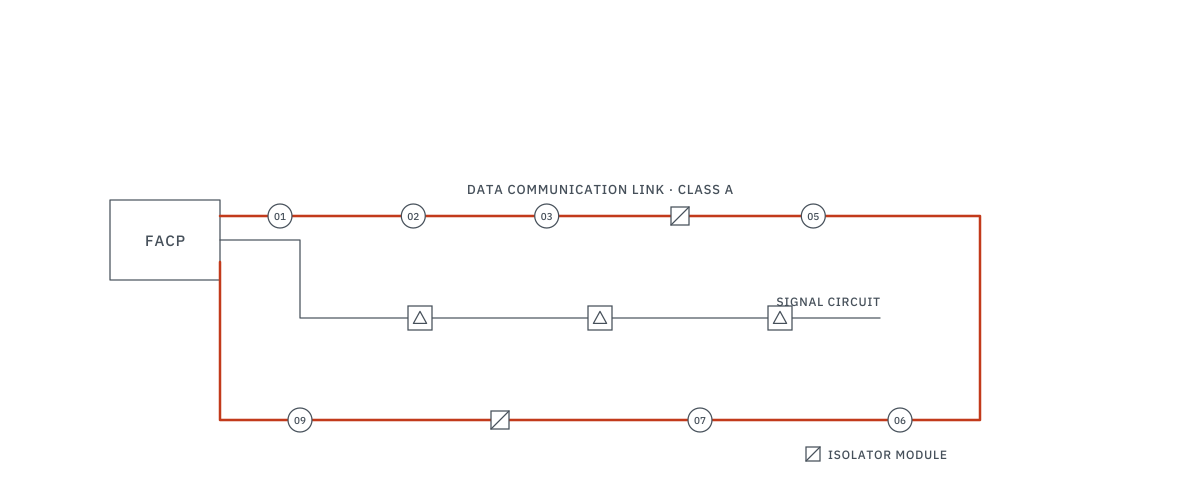
An addressable fire alarm system assigns a unique digital address to every device on the Signaling Line Circuit (SLC). The panel continuously polls each device, asking: "What's your status?" Each device reports back its condition - normal, alarm, trouble, or specific analog readings.
How It Works
The SLC loop is a communication circuit (typically a single twisted pair) that connects up to several hundred devices (e.g. 250 or 318) depending on the panel manufacturer. Unlike conventional zones, addressable devices communicate digitally with the panel. The panel knows the exact location and status of every device at all times.
"With an addressable system, the panel display reads 'Smoke Detector - 2nd Floor - Room 217 - Sensor reading 5.8%/m.' With a conventional system, it reads 'Zone 3 - Alarm.' The difference in emergency response time is significant."
Key Advantages
- Exact device identification - pinpoint the alarming device
- Analog sensing - detectors report drift, enabling predictive maintenance
- Less wiring - one SLC loop can replace dozens of zone circuits
- Flexible programming - cross-zone verification, day/night sensitivity
- BAS integration - interfaces with building automation systems
Head-to-Head Comparison
| Feature | Conventional | Addressable |
|---|---|---|
| Device Identification | Zone-level only | Individual device |
| Wiring Topology | Home run per zone | Single SLC loop |
| Devices per Circuit | ~20 per zone | Several hundred per SLC |
| Wiring Cost | Higher (more wire runs) | Lower (fewer runs) |
| Equipment Cost | Lower (simpler panel) | Higher (intelligent panel) |
| Total Installed Cost (Small) | Lower | Higher |
| Total Installed Cost (Large) | Higher | Lower |
| Maintenance | Manual identification | Self-diagnostics |
| Expandability | Limited by zones | Highly scalable |
| BAS Integration | Basic relay-only | Full protocol support |
When to Specify Which?
Use Conventional When:
The building is small (under ~930 m²), has a simple floor plan, few zones are needed (typically under 8), and budget is the primary constraint. Common examples: small retail stores, single-tenant offices, small industrial or storage buildings.
Use Addressable When:
The building is multi-story, has complex floor plans, requires fire department annunciator panels, needs integration with elevator recall or HVAC shutdown, or where maintenance and long-term operating costs are factored into the decision. Common examples: commercial high-rises, hospitals, schools, institutional facilities, any building over ~1,400 m².
Wiring Considerations
One of the most impactful differences is wiring topology. Consider a 5-story commercial building with 10 zones per floor:
- Conventional: 50 separate zone circuits, each running from the panel to its zone - potentially kilometres of wire.
- Addressable: 2-3 SLC loops serving all 250+ devices, with Class A wiring providing redundant path protection.
The wiring cost savings alone can offset the higher equipment cost of an addressable system in buildings of this scale. Per Edwards (EST) Signature guidelines, SLC loops use twisted-pair cable; shielded cable is required only where electrical noise is very high.
Ontario Code Context
The Ontario Building Code and CAN/ULC-S524 do not explicitly mandate one type over the other. However, the functional requirements - annunciator display, zone identification for firefighter response, elevator recall control - often make addressable systems the practical choice for many buildings requiring a fire alarm system under OBC Subsection 3.2.4.
Frequently Asked Questions
Addressable vs conventional: what's the difference?
Conventional = zone-level. Addressable = device-level location and diagnostics. The OBC does not mandate either type. See our fire detector guide.
When is addressable required?
Not by the OBC; it is the usual choice for two-stage and voice-communication systems and where zone-level ID is insufficient. See our permit guide.
Is addressable more expensive?
Panel costs more, but wiring is simpler. For larger systems, addressable is often cheaper overall due to reduced labour.