Generator Sizing & Step Loading: Avoiding the #1 Emergency Power Mistake
A hospital's backup generator starts during a blackout. The ATS transfers life-safety loads. Then the HVAC kicks in - and the generator stalls. 200 patients are in the dark. The cause? The engineer sized the generator for running load but ignored step loading. Here's how to avoid this catastrophic mistake.
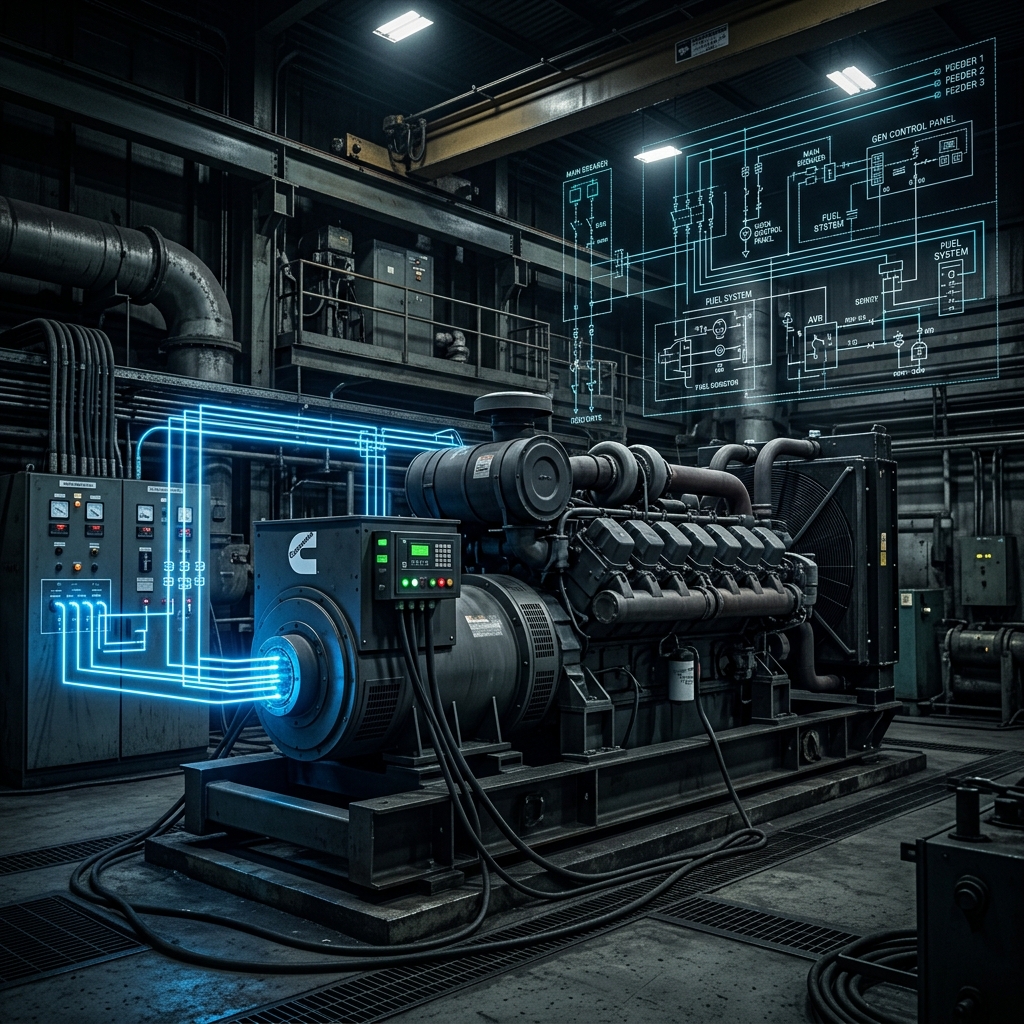
kW vs. kVA: The First Trap
Generators are rated in both kW (real power) and kVA (apparent power). These are NOT the same thing. The relationship is governed by power factor:
The Relationship:
kW = kVA - Power Factor (PF)
Typical Generator Rating:
500 kW / 625 kVA at 0.8 PF
A generator rated 500 kW can only deliver 500 kW even if the kVA demand is lower. If your load has a PF of 0.7, you need: kVA = 500/0.7 = 714 kVA, requiring a larger generator.
What is Step Loading?
Step loading is the practice of sequencing emergency loads onto the generator in planned stages rather than connecting everything simultaneously. This is critical because:
- Motor starting current is 5-7" the running current. A 50HP motor runs at 65A but starts at 400A
- Voltage dip during motor starting must stay within 15-20% or motors won't start and lights will visibly flicker
- Frequency dip from sudden load application can cause the generator to stall if it exceeds the governor's recovery capability
The #1 rule of generator sizing: Never apply more than 50% of the generator's rated capacity in a single step. Most manufacturers recommend individual steps not exceeding 30% of rated kW.
Step Loading Sequence Example
For a 400 kW generator serving a 6-storey commercial building:
| Step | Time Delay | Loads Connected | Step kW | Cumulative kW | % of Gen |
|---|---|---|---|---|---|
| 1 | 0 sec (immediate) | Emergency lighting, fire alarm, exit signs | 25 | 25 | 6% |
| 2 | 10 sec | Fire pump (jockey + main) | 75 | 100 | 25% |
| 3 | 20 sec | Elevators (one car at a time) | 45 | 145 | 36% |
| 4 | 30 sec | Stairwell pressurization fans | 60 | 205 | 51% |
| 5 | 45 sec | Critical HVAC (server room cooling) | 80 | 285 | 71% |
| 6 | 60 sec | Selected receptacles, BAS, security | 55 | 340 | 85% |
Notice that no single step exceeds 80 kW (20% of generator capacity), and the largest motor load (fire pump at Step 2) is applied when the generator is lightly loaded, giving it maximum headroom for the starting transient.
CEC Section 46: Emergency Power Requirements
The Canadian Electrical Code, Section 46, defines the requirements for emergency power systems in buildings:
| Requirement | CEC Reference | Key Detail |
|---|---|---|
| Emergency power source | Rule 46-202 | Rechargeable battery system or generator, with duration tied to building-code requirements |
| Automatic transfer control | Rule 46-206 | Emergency power supply controlled by automatic transfer equipment upon normal supply failure |
| Emergency wiring methods | Rule 46-108 | Life-safety conductors must use approved emergency wiring methods and separation where required |
| Overcurrent coordination | Rule 46-208 | Emergency supply OCP must be coordinated with life-safety feeders and branch circuits |
| Transfer timing / fuel / testing | OBC/NBC + CSA C282 | Confirm start time, fuel supply, room/exterior installation, maintenance, and load testing under the applicable building and generator standards |
| Unit equipment | Rules 46-302 / 46-304 | Applies to emergency lighting unit equipment, not generator transfer-time requirements |
Generator Sizing: The Complete Checklist
- Running load: Sum of all continuous loads at their demand values (kW and kVA)
- Starting load: Largest motor starting kVA in each step + running kVA of everything already connected
- Altitude derating: Generators lose ~3.5% capacity per 1,000 ft above 500 ft elevation
- Temperature derating: Above 40°C ambient, capacity drops ~2% per additional °C
- Future growth: Typically 15-25% spare capacity for additional loads
- Harmonic loads: UPS systems, VFDs, and LED drivers create harmonics that derate the alternator
Common Sizing Mistakes
- Sizing for running load only - ignoring motor starting transients is the most common cause of generator stalling on transfer
- No step loading sequence - connecting all loads simultaneously through a single ATS with no time delays
- Confusing kW and kVA - a 500 kVA generator at 0.8 PF only delivers 400 kW. Specifying "500" without units leads to undersizing
- Undersizing for UPS loads - UPS input current is non-linear. The generator alternator must be oversized by 1.5-2" for harmonic loads
- No load bank testing - a generator that passes a monthly no-load test may still stall under real load. Annual load bank testing is essential
Frequently Asked Questions
What's the difference between kW and kVA?
kW is real power; kVA is apparent power. kVA = kW ÷ power factor (typically 0.8). A 100 kW generator is actually 125 kVA. Always size in kVA.
What is step loading?
The sequence in which loads are applied after generator startup. Motors cause 6-8x inrush currents. Proper sequencing prevents voltage/frequency dips. See our load calculation guide.
Does CEC require emergency generators?
CEC Section 46 governs emergency power wiring, control, and overcurrent protection where emergency power is required. Building triggers, duration, generator performance, fuel supply, and testing must also be checked against OBC/NBC and CSA C282. See our permit guide for compliance.
Download the Generator Sizing Worksheet
Get our step loading calculation spreadsheet - pre-formatted with motor starting multipliers, derating factors, and ATS sequencing templates.
Need a Generator Sizing Study?
ETEM Engineering performs comprehensive generator sizing, step loading analysis, and ATS coordination for hospitals, data centers, high-rises, and industrial facilities. We deliver code-compliant emergency power designs that work when it matters most.
Get a Free Consultation