Electrical Room Design: The CEC Clearances That Kill Floor Plans
"The architect gave us a 6-8 ft room for a 1200A service." Sound familiar? Electrical rooms are where architecture meets code reality - and code always wins. Here are the CEC clearance requirements, door rules, and layout constraints that determine whether your electrical room is buildable or a red-tag waiting to happen.
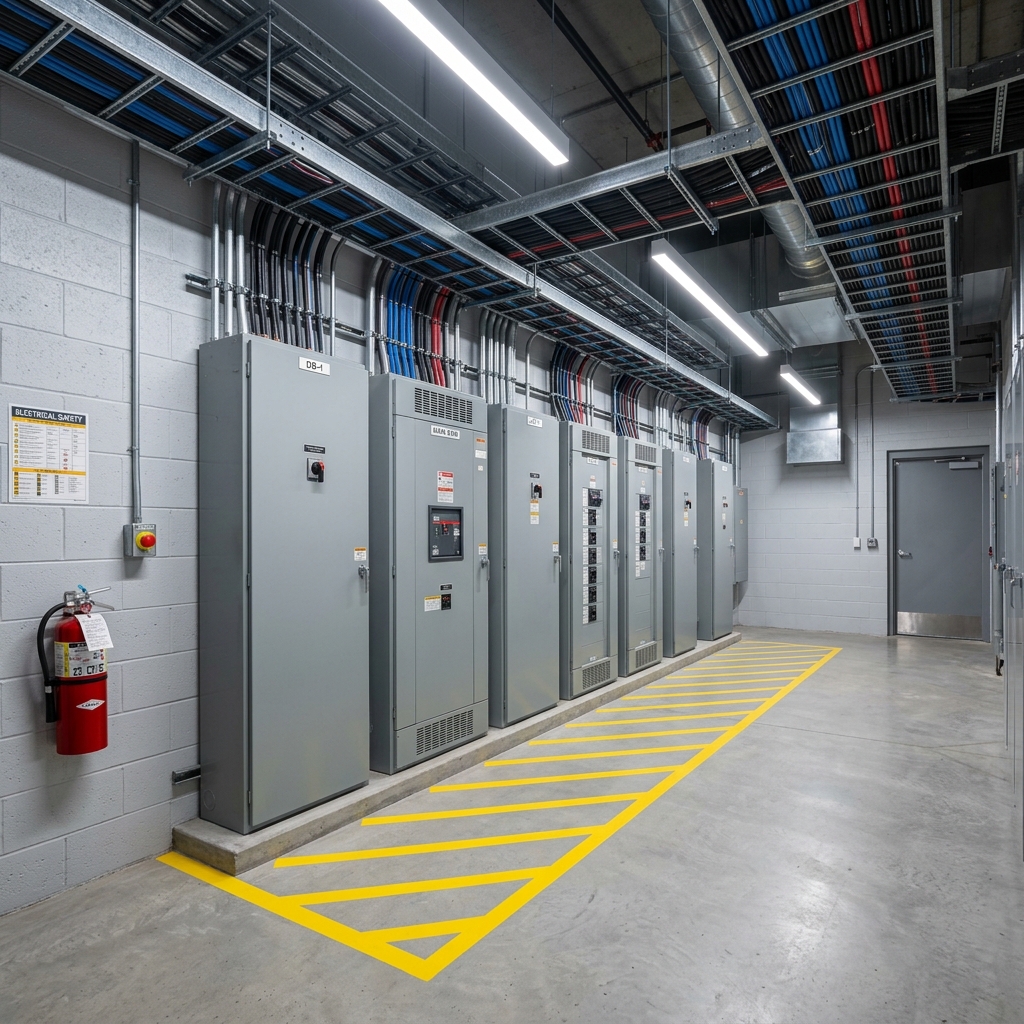
Working Space Requirements (CEC Rule 2-308)
The CEC mandates minimum clear working space in front of all electrical equipment. These dimensions cannot be compromised - no pipes, ducts, or storage in the working space.
| Voltage to Ground | Condition 1 (exposed live on one side) | Condition 2 (exposed live on both sides) | Condition 3 (concrete/grounded on opposite side) |
|---|---|---|---|
| 0-150V | 1.0m (3 ft) | 1.0m (3 ft) | 1.0m (3 ft) |
| 151-600V | 1.0m (3 ft) | 1.2m (4 ft) | 1.5m (5 ft) |
| 601V"2500V | 1.2m (4 ft) | 1.5m (5 ft) | 1.8m (6 ft) |
Critical dimension: For a typical 347/600V service (most commercial buildings in Ontario), you need minimum 1.0m (3 ft) clear in front of all panels - but if there's concrete or a grounded surface behind the worker, it jumps to 1.5m (5 ft). This single requirement often doubles the room size architects planned.
Working Space Width & Height
| Dimension | CEC Requirement | Practical Note |
|---|---|---|
| Width | 750mm (30 in) or width of equipment, whichever is greater | A 36" wide panelboard needs 36" clear width minimum |
| Height | 2.0m (6.5 ft) minimum | Dropped ceilings, sprinkler pipes, and cable trays cannot reduce clearance below 2.0m |
| Depth | Per voltage table above | Measured from front face of equipment to nearest obstruction |
Egress Requirements (CEC Rule 2-310)
- Rooms and working spaces must have unobstructed means of egress coordinated with the National Building Code
- For equipment rated 1200A or more, or over 750V, arrange egress so a worker can leave without passing the potential failure point
- Where that arrangement is not possible, Rule 2-310 requires increased working space clearance of at least 1.5m
- Doors or gates must be readily opened from the equipment side without a key or tool
- Door swing, width, panic hardware, and fire separation are normally finalized through OBC/NBC and AHJ coordination
Dedicated Room & Vault Coordination
Large switchboards, transformers, service equipment, and utility metering often need a dedicated electrical space because of working clearances, egress, fire separation, ventilation, utility standards, and constructability. OESC Rule 26-350 applies specifically to electrical equipment vaults, not as a blanket trigger for every 600A room.
- Working-space protection - keep piping, ducts, storage, and trade equipment out of required electrical working clearances
- Utility and AHJ coordination - service rooms, CT cabinets, and transformer spaces may have utility-specific requirements beyond the OESC minimums
- Fire separation - confirm OBC/NBC fire-resistance requirements for the specific equipment, occupancy, and room use
- Adequate ventilation - transformer rooms require ventilation sized for heat dissipation (typically 100 CFM per kW of losses)
- Emergency lighting - required per OBC for all electrical equipment rooms
Common Coordination Failures
| Problem | What Happens | Prevention |
|---|---|---|
| Architect sizes room too small | Equipment doesn't fit with required clearances - room must be enlarged during construction | Involve electrical engineer at schematic design stage |
| Mechanical runs pipes through E-room | CEC violation - pipes must be rerouted at contractor's expense | BIM coordination meetings with clash detection |
| Single door on 800A service | Code violation - second door must be cut into fire-rated wall | Review door count during permit drawing phase |
| No floor drain or sump | Water ingress during pipe break damages equipment | Install recessed sump with moisture alarm |
Frequently Asked Questions
What are the CEC clearance requirements?
Min 1m for standard panels, 1.2m for >150V or >200A, 1.5m for >600V. See our service entrance guide for sizing.
When is a dedicated electrical room required?
Dedicated electrical space is driven by equipment clearances, egress, fire separation, utility rules, and AHJ requirements. Rule 26-350 is a vault rule, not a blanket 600A room trigger. See our grounding guide.
What are the door requirements?
Rule 2-310 requires unobstructed egress and doors or gates that open from the equipment side without a key or tool. For equipment rated 1200A or more, or over 750V, egress must be arranged so workers can leave without passing the failure point.
Download the Electrical Room Sizing Checklist
Get our checklist covering CEC clearances, door requirements, ventilation sizing, and the items architects most commonly miss.
Need Electrical Room Design Support?
ETEM Engineering provides electrical room layout design, clearance verification, and equipment coordination drawings to ensure your room is code-compliant before construction begins.
Get a Free Consultation