Conduit Fill & Raceway Sizing: CEC Table 8 Explained
Oversized conduit wastes material. Undersized conduit fails inspection and damages wire insulation during pulling. CEC Table 8 defines the maximum fill - here's how to use it correctly.
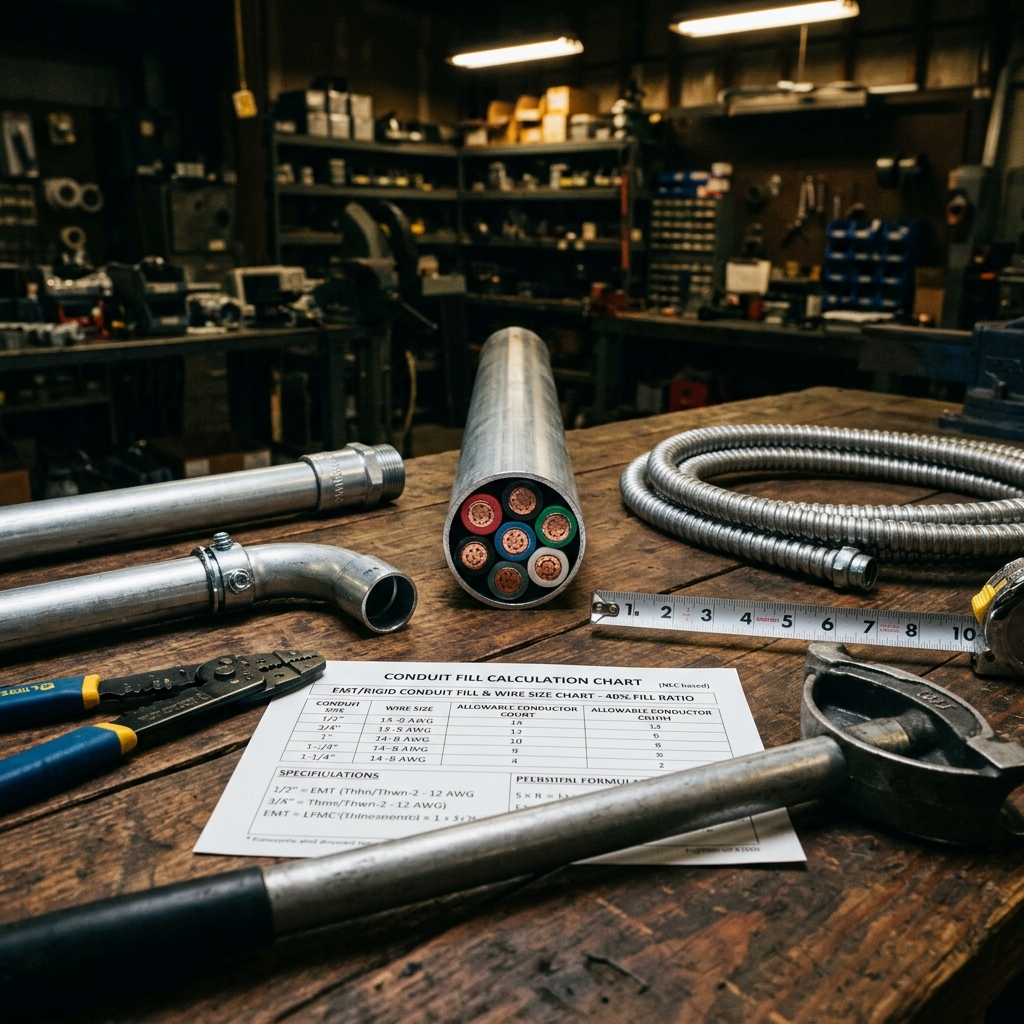
CEC Rule 12-910: Maximum Conduit Fill
The CEC limits the percentage of a conduit's internal cross-sectional area that can be occupied by conductors:
| Number of Conductors | Maximum Fill (%) | Rationale |
|---|---|---|
| 1 conductor | 53% | Single conductor fills half the conduit - easy pull |
| 2 conductors | 31% | Two wires jam more easily - reduced fill |
| 3 or more | 40% | Standard multi-conductor fill - most common scenario |
Why not 100%? Conductors need space to dissipate heat. Overfilling causes higher operating temperatures, insulation degradation, derating, and potential fire hazard. The fill percentages also allow for practical wire pulling without damaging insulation.
Conduit Types Comparison
| Type | Trade Name | Use | Internal Area (1") |
|---|---|---|---|
| EMT | Electrical Metallic Tubing | Indoor dry locations, most common commercial | 443 mm² |
| Rigid | Rigid Metal Conduit (RMC) | Exposed, outdoor, industrial - heavy duty | 458 mm² |
| PVC | PVC Rigid Conduit | Underground, corrosive environments | 474 mm² |
| Flex | Flexible Metal Conduit | Equipment connections, vibration isolation | Varies - limited to 1.8m max length |
| LFMC | Liquid-Tight Flexible | Wet locations, rooftop equipment, A/C units | Varies - limited to 1.8m |
Step-by-Step Conduit Sizing
- 1. List all conductors - size, type (THHN, TECK, RW90), including grounds and bonding
- 2. Look up conductor area - CEC Table 10 gives cross-sectional area (mm²) for each conductor including insulation
- 3. Sum total conductor area - add all conductor areas together
- 4. Determine fill percentage - 53% (1 wire), 31% (2 wires), or 40% (3+ wires)
- 5. Select conduit - CEC Table 8 gives maximum area for each conduit size at each fill percentage. Choose the smallest conduit where allowable area total conductor area
Quick Reference: Common Scenarios
| Circuit | Conductors | Total Area | Min EMT Size |
|---|---|---|---|
| 15A lighting circuit | 2 × #14 + 1 × #14 bond | ~28 mm² | 1/2" (trade 16) |
| 20A receptacle circuit | 2 × #12 + 1 × #12 bond | ~35 mm² | 1/2" (trade 16) |
| 3Φ motor branch (30A) | 3 × #10 + 1 × #10 bond | ~59 mm² | 3/4" (trade 21) |
| 100A feeder | 3 × #3 + 1 × #6 bond | ~165 mm² | 1-1/4" (trade 35) |
| 200A feeder | 3 × 3/0 + 1 × #4 bond | ~335 mm² | 2" (trade 53) |
| 400A feeder | 3 × 500kcmil + 1 × #2 bond | ~650 mm² | 3" (trade 78) |
Common Mistakes
| Mistake | Why It's Wrong | Correct Approach |
|---|---|---|
| Forgetting the bonding conductor | Bond conductor counts toward fill - can push you to the next conduit size | Always include the bonding/grounding conductor in area calculations |
| Mixing conductor types | Different insulation types have different diameters - can't use "all same size" tables | Calculate area individually for each conductor type |
| Using 40% fill for 2 conductors | 2 conductors = 31% max, not 40% | Check conductor count first, then apply correct fill percentage |
| Not accounting for cable vs conductor | Cables (NMD90, TECK) use outer diameter, not individual conductor area | Use cable OD to calculate area: - (OD/2)² |
| Ignoring pull tension on long runs | >30m runs or multiple bends may need upsizing even if fill is technically OK | Limit to 2-90° bends between pull points, or upsize conduit |
Derating When Conduits Are Full
When many current-carrying conductors share a conduit, ampacity derating applies per CEC Table 5C:
| Current-Carrying Conductors | Derating Factor |
|---|---|
| 1-3 | 100% (no derating) |
| 4-6 | 80% |
| 7-24 | 70% |
| 25-42 | 60% |
| 43+ | 50% |
Neutral conductors carrying only unbalanced current are not counted as current-carrying. However, neutrals carrying harmonic currents (3rd harmonic from non-linear loads like LEDs) must be counted.
Frequently Asked Questions
What is the maximum conduit fill?
CEC Rule 12-910: 53% for 1 conductor, 31% for 2, 40% for 3+. Always calculate using conductor OD including insulation.
How do I size conduit for multiple wires?
Sum conductor areas, divide by 40% (for 3+ wires), select conduit with sufficient internal area. Check voltage drop for long runs.
Does conduit fill affect ampacity?
Yes. More than 3 current-carrying conductors require ampacity derating per CEC Table 5C: 4-6 wires = 80%, 7-24 = 70%.
Download the Conduit Fill Quick Calculator
Get our printable conduit fill reference card with common scenarios, conductor areas, and EMT/Rigid/PVC sizing tables.
Need Raceway Design Engineering?
ETEM Engineering provides complete conduit and raceway design - from branch circuits to feeder sizing, pull box locations, and coordination drawings.
Get a Free Consultation